FOR FOUNDERS, BUSINESS OWNERS AND LEADERSHIP TEAMS
Are customers choosing you for the reasons you think?
A practical method and workbook to compare your team’s assumptions with customer behavior—and decide what to protect, change, or test next.
HOW IT WORKS · IN 45 SECONDS
- 1Write down what you believeThe leader, alone · about an hour
- 2Your team checks it, blindAnswers hidden until all are in · 20 min each
- 3The market checks itCustomers, then an outside read
THE GAP
What you planned versus what customers actually do.
Every brand has a gap between the customer it was built for and the one who actually shows up. Pick your stage to see what it looks like.
The brand you planned is a hypothesis. Expect it to be at least partly wrong by customer 20.
ICP ON THE WALL
Athletes
Gym-goers who want a high-protein tortilla for recovery.
WHO SHOWED UP
28 of the first 40 were new or expecting mothers
Six meal-preppers and four parents packing school lunches. Two athletes. Nobody said “protein.”
Mesa Foods is the fictional worked example in the Startup workbook.
What you think customers buy is rarely what they come back for.
BUILT AROUND
Single-origin sourcing
Two years of supplier relationships and origin cards on the menu.
WHY THEY COME BACK
A calm place to sit and think
Asked directly, three of five customers said the store felt calm. Not one mentioned sourcing.
Trail Coffee Co. is the fictional worked example in the Builder workbook.
Growth pulls the message toward new buyers, and away from the customers who built you.
NOW PITCHING
Volume capacity and SLA compliance
The story for the large corporate accounts.
WHO STILL STAYS
Property managers who treat them as infrastructure
Still the highest-retention customers, and they refer each other. Close rates in that original market are falling.
Meridian Field Services is the fictional worked example in the Scale workbook.
Ask five leaders what the company does. Five different answers means drift.
THE CEO SAYS
“The operational backbone of mid-market companies”
Sales, product, marketing and customer success each gave a different answer.
WHAT CUSTOMERS HIRED THEM FOR
“Never get blamed for a missed handoff again”
How early customers described it in their renewal emails. The website says none of it now.
Vertex Systems is the fictional worked example in the Enterprise workbook.
EDITIONS
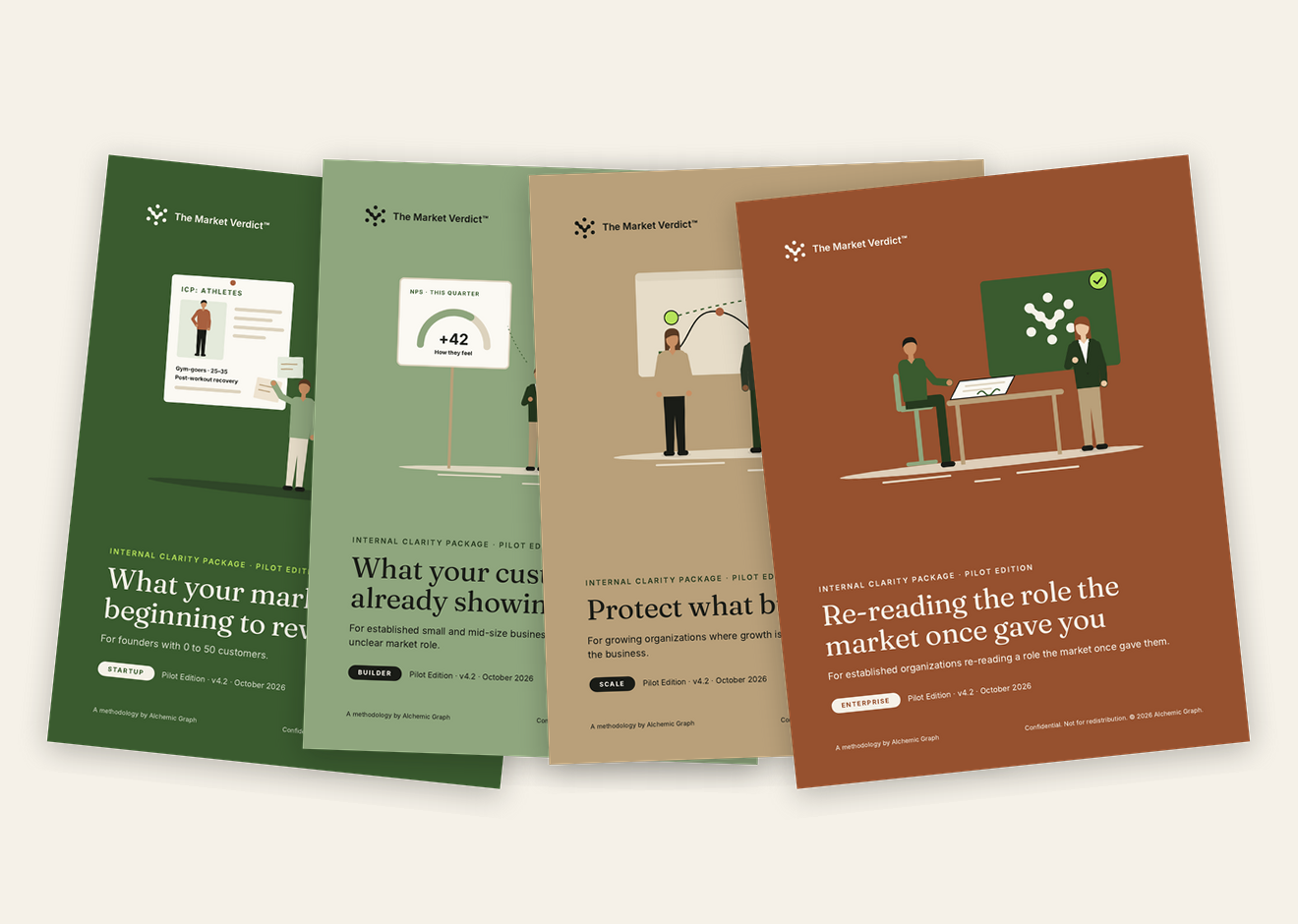
One method, matched to where you are.
Choose by how much customer evidence you have, not just company size. Each edition has its own tool: Startup’s evidence log works before you have customers, Builder’s churn-call log, Scale’s original-versus-growth comparison, Enterprise’s retention by segment.
Startup
For founders testing an idea or learning from their first customers. Mostly you, working as customers arrive.
Freeduring the pilot · paid editions later
Join the free pilot
- YOUR TOOL IN STEP 3 The Startup tool An evidence log of what people actually did when offered something, and what it cost them.
- THE OUTSIDE READ · INCLUDED IN THE PILOT Your outside read Idea Intelligence Assessment
- THE TEAM STEP (STEP 2) Optional for solo founders · co-founders answer alone If you have co-founders or early team members, they answer the same questions independently. Working solo? Skip it and go to Step 3.
Builder
For businesses with real customers that need a clearer picture of why customers choose them.
Freeduring the pilot · paid editions later
Join the free pilot
- YOUR TOOL IN STEP 3 The Builder tool A churn-call log beside a table of customers’ own words.
- THE OUTSIDE READ · INCLUDED IN THE PILOT Your outside read Brand Intelligence Report
- THE TEAM STEP (STEP 2) About 20 minutes each · five people, alone The same questions, answered independently. Nobody sees anyone else’s answers until all are in.
Scale
For growing companies where new demands may be changing what customers value.
Freeduring the pilot · paid editions later
Join the free pilot
- YOUR TOOL IN STEP 3 The Scale tool Original customers and growth customers, side by side on the same measures.
- THE OUTSIDE READ · INCLUDED IN THE PILOT Your outside read Brand Intelligence Report
- THE TEAM STEP (STEP 2) About 20 minutes each · five people, alone The same questions, answered independently. Nobody sees anyone else’s answers until all are in.
Enterprise
For organizations reassessing their role across customer groups, teams or business units.
Freeduring the pilot · paid editions later
Join the free pilot
- YOUR TOOL IN STEP 3 The Enterprise tool Retention by segment and buyer.
- THE OUTSIDE READ · INCLUDED IN THE PILOT Your outside read Brand Intelligence Report
- THE TEAM STEP (STEP 2) About 20 minutes each · five people, alone The same questions, answered independently. Nobody sees anyone else’s answers until all are in.
EVERY EDITION
The same five steps
Only the tool, the outside read and the team step change by edition. See them together in the five-stage diagram on the Method page.
-
1Write down what you believe About an hour · the leader, alone Six questions, answered in writing before anyone else. Each answer is marked Known or Assumed. It’s a record, not a draft.
-
2See if the team agrees Startup: optional for solo founders, co-founders answer alone · Builder, Scale, Enterprise: about 20 minutes each, five people, alone The same questions, answered independently. Nobody sees anyone else’s answers until all are in. Working solo? Skip it and go to Step 3.ALIGNED No gaps doesn’t mean the team is right. It means you share one story. Everyone goes on to Step 3, because customers may not share it.ANY GAP Every gap goes into Step 3, where customer behavior settles it. Nobody votes on the right answer.
-
3Check it against customers Two working sessions · customer contact between Collect what customers say unprompted, log what they do that doesn’t fit, run the four signal checks, and write your Brand Brief. Each edition has its own tool for this step, shown above.
-
4THE OUTSIDE READ · INCLUDED IN THE PILOT Idea Intelligence Assessment (Startup) or Brand Intelligence Report (Builder, Scale, Enterprise) Independent · public evidence only Research starts after you finish Steps 1 and 2. The researcher never sees your workbook. You save a dated, sealed copy of your findings before you see the report.
-
5Crosscheck Your sealed findings vs the outside read You compare them claim by claim with the Crosscheck worksheet. Agreement supports a claim; it doesn’t prove it. Where they differ, the better-supported evidence wins.
HOW THE METHOD WORKS
Four rules we hold ourselves to.
Behavior over opinion
Repeat orders, unprompted referrals and full-price purchases count. Compliments and survey answers don’t decide anything.
Written to be proven wrong
Before you look at evidence, you write down what would show your belief is wrong. If nothing could change your mind, it’s a belief.
Nothing settled alone
Crosscheck sets what you believe against an independent outside read. Agreement supports a claim; it doesn’t prove it.
Your team answers blind
Leaders and co-founders answer on their own first. Nobody sees anyone else’s answers until all of them are in.
CASE NOTES
All case notes
Writing on brands, signals and the method.
METHOD
Where The Market Verdict™ comes from
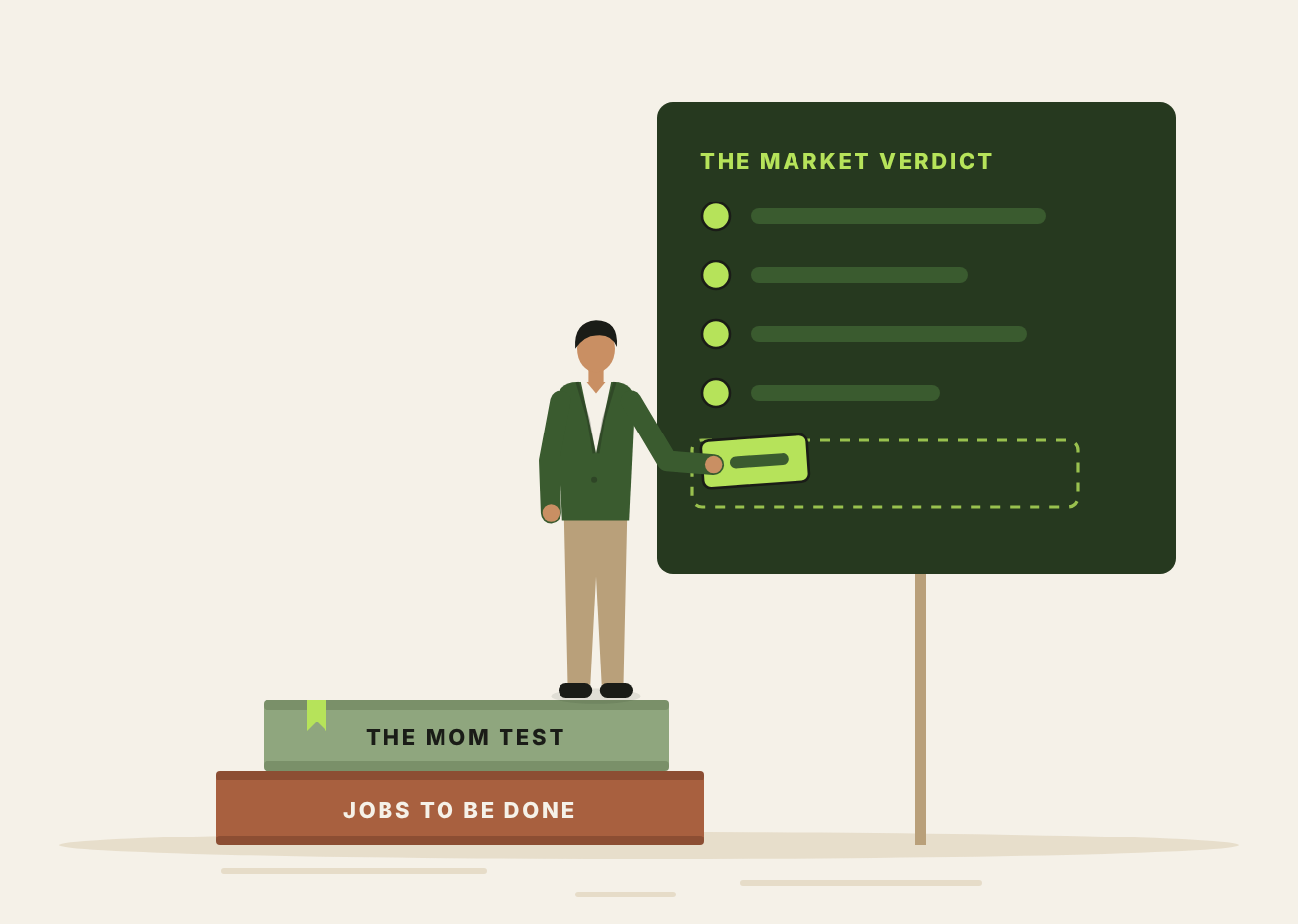
The Market Verdict starts where The Mom Test and Jobs to Be Done leave off. What it took from them, what it adds, and where it is still thinner.
PILOT
Inside the workbooks
What you actually get when your pilot place opens, page by page: one workbook, three steps and a one-page Brand Brief.
METHOD
Use NPS to monitor. Use The Market Verdict to diagnose.
NPS measures how likely customers say they are to recommend you. It can’t tell you why, or what role you play in their lives.