Worked example: Velmont Outdoor
Velmont Outdoor (fictional) makes outdoor jackets and packs. It was built on one promise: buy once, repair for life. It’s now growing fast through a cheaper “Lite” line and 220 big-box stores. The CEO believes the growth is the brand now. Here’s what happened when the team tested that belief.
-
STAGE 1 · WEEK 1
They join the pilot
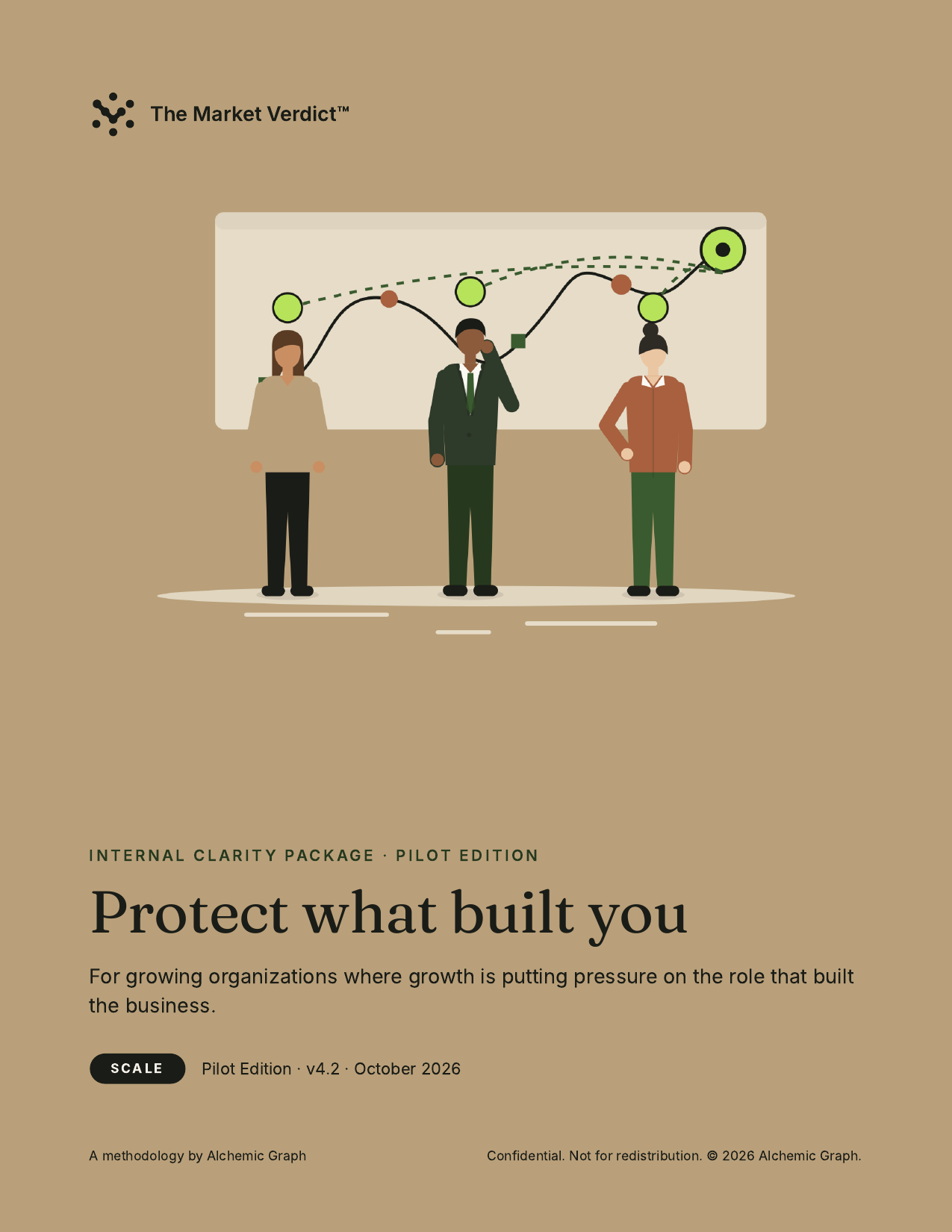 Full page ↗
The Scale workbook. Fictional example. Velmont is a growing company, so it gets the Scale edition. The workbook is the main tool; the team runs it themselves.
-
STAGE 2 · WEEK 2
Step 1: the CEO writes what she believes, alone
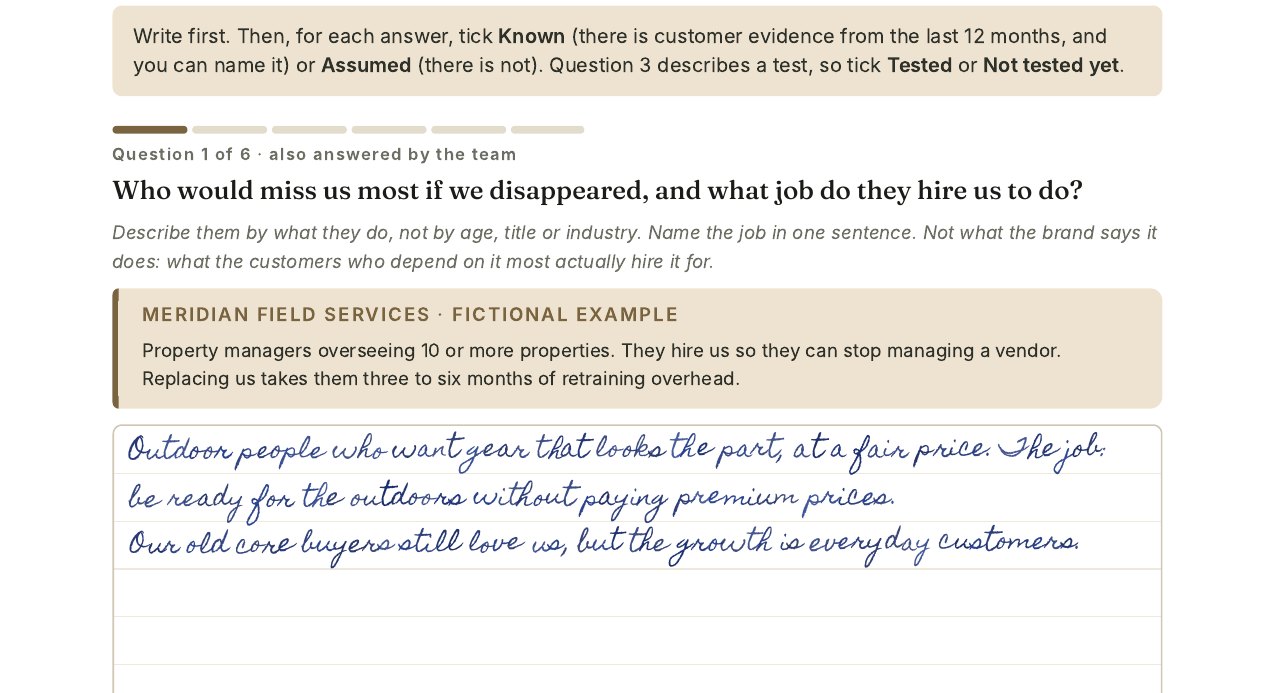 Full page ↗
The CEO’s answer to Question 1. Fictional example. 1Question 1. She describes the growth plan’s customer: ‘gear that looks the part, at a fair price’.
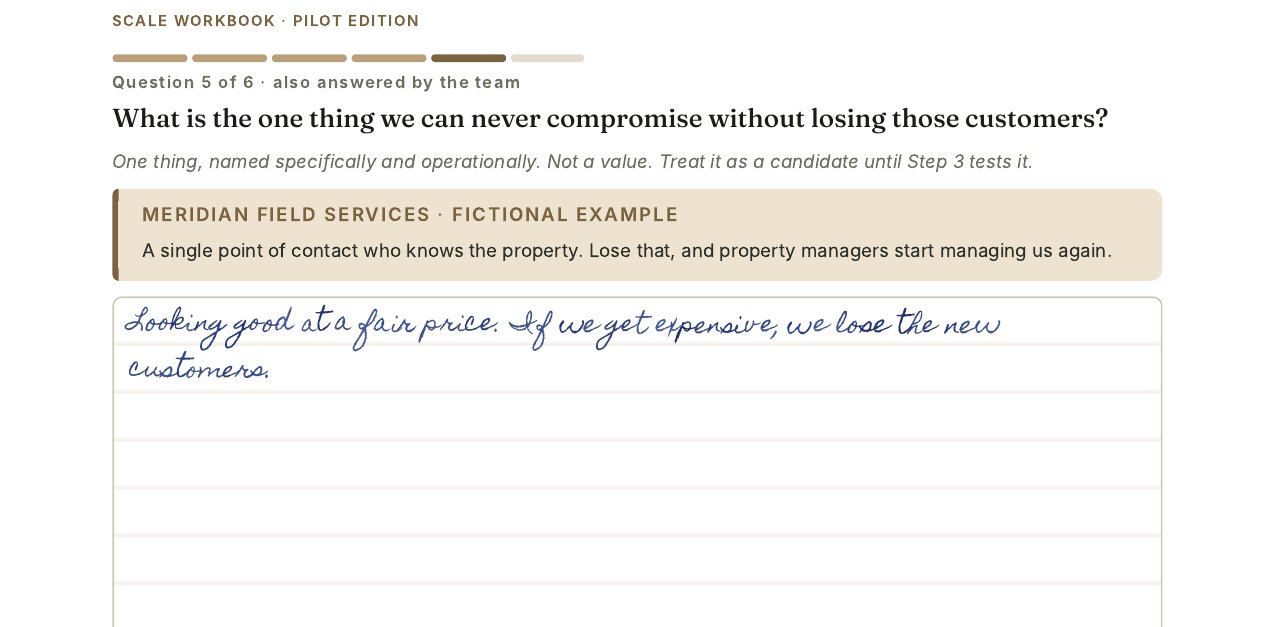 Full page ↗
The CEO’s answer to Question 5. Fictional example. 2What can never be compromised? ‘Looking good at a fair price.’ Keep this one in mind.
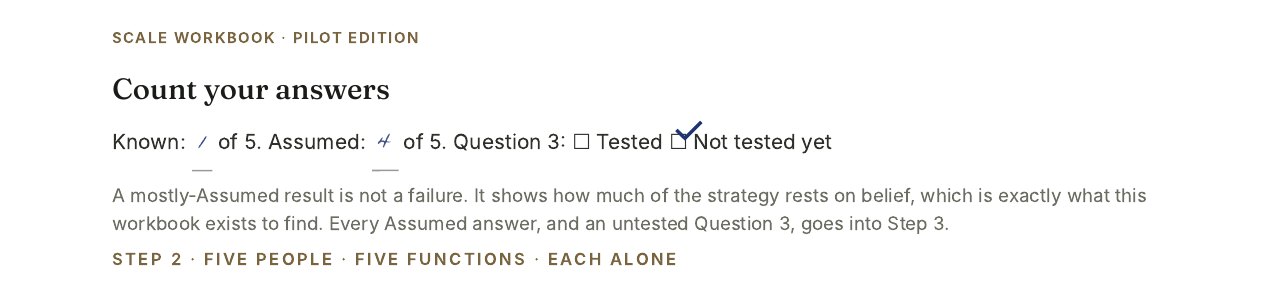 Full page ↗
The CEO’s Known and Assumed count. Fictional example. 31 Known, 4 Assumed. That isn’t a failure: it shows how much of the strategy rests on belief.
Her test (Question 3), written before anyone looked: if Lite buyers don’t buy again within 12 months, the growth plan is wrong.
-
STAGE 3 · WEEK 3
Step 2: five leaders answer the same questions, alone
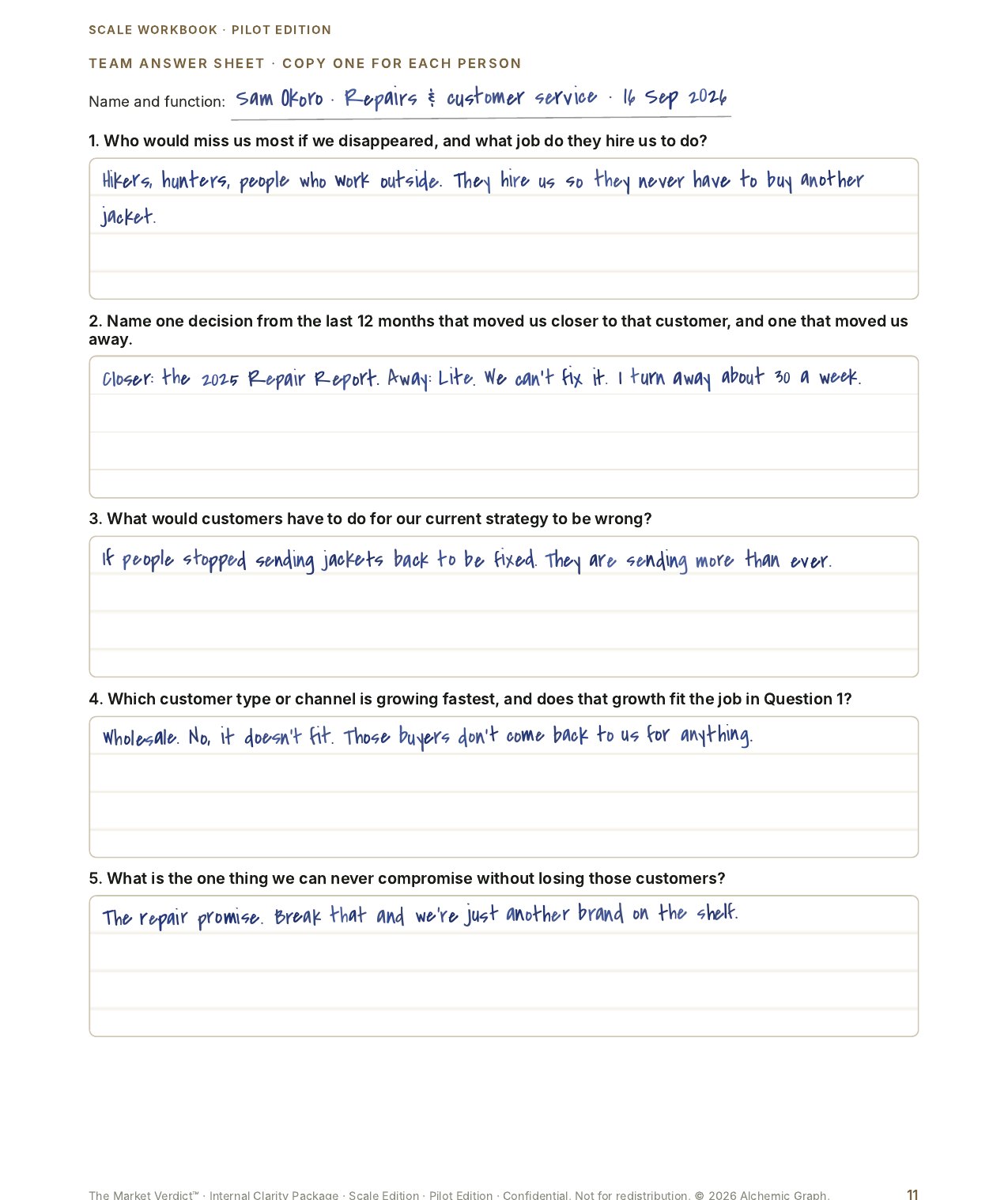 Full page ↗
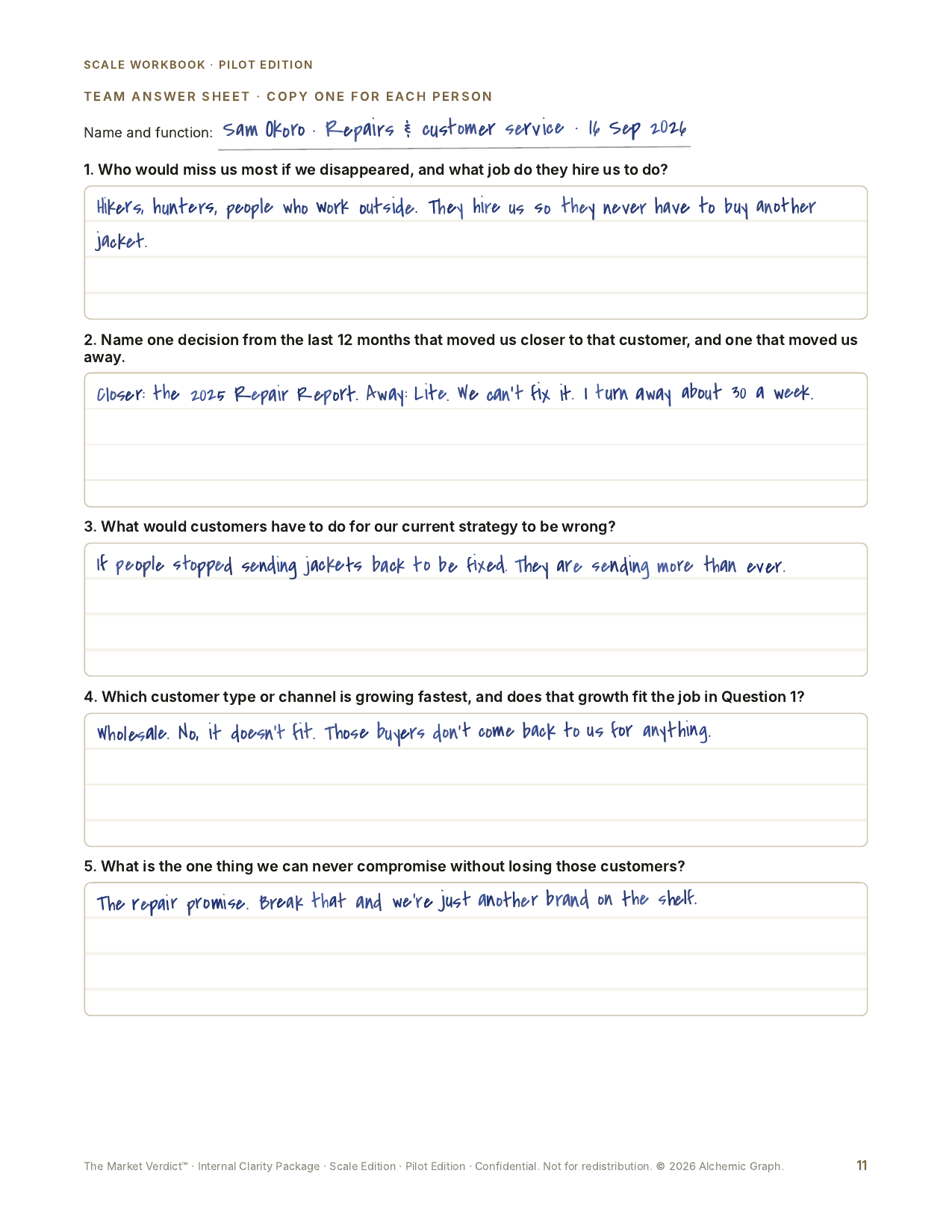
Sam’s team sheet. Fictional example. 4Sam runs repairs: ‘The repair promise. Break that and we’re just another brand on the shelf.’
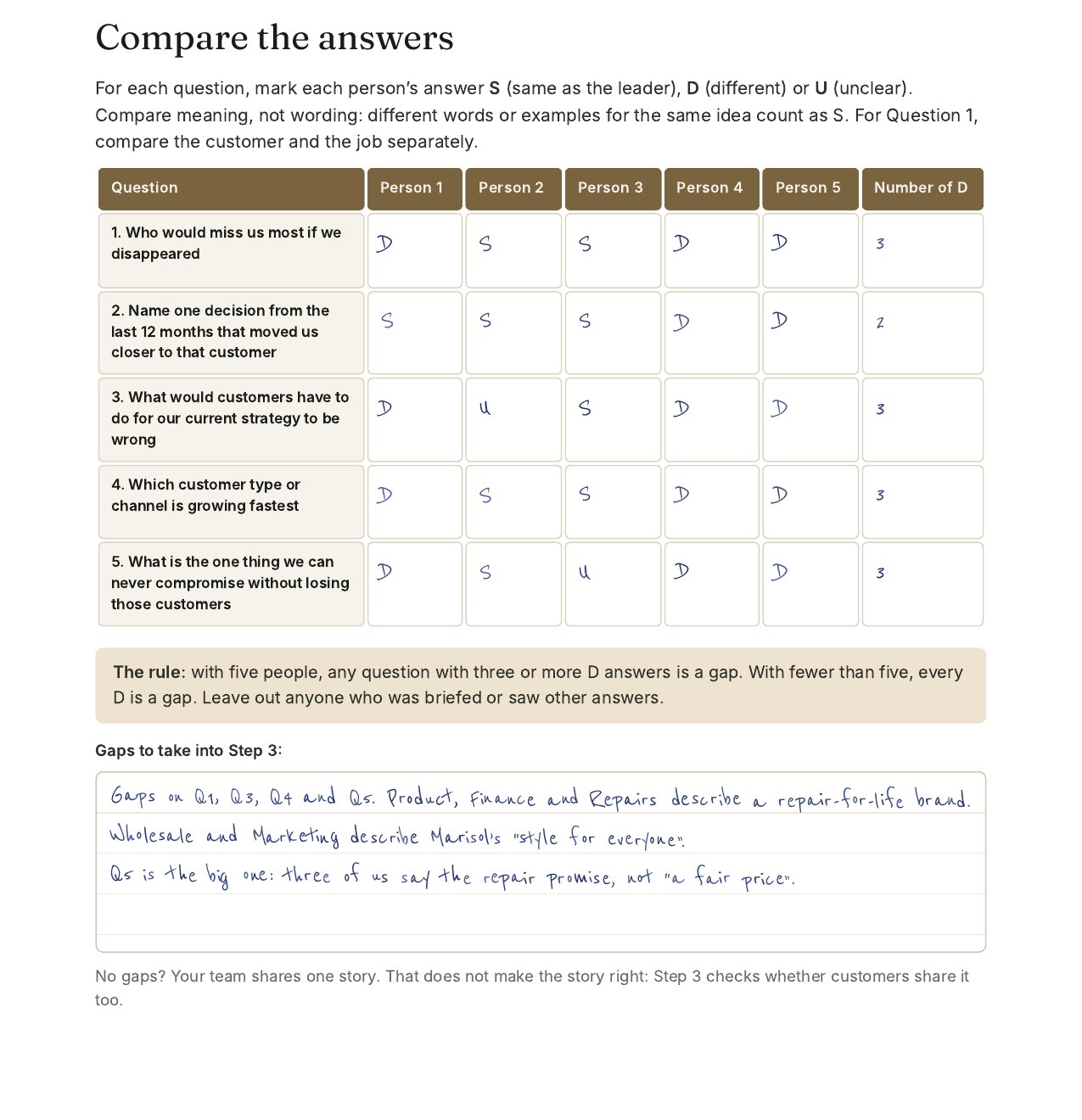 Full page ↗
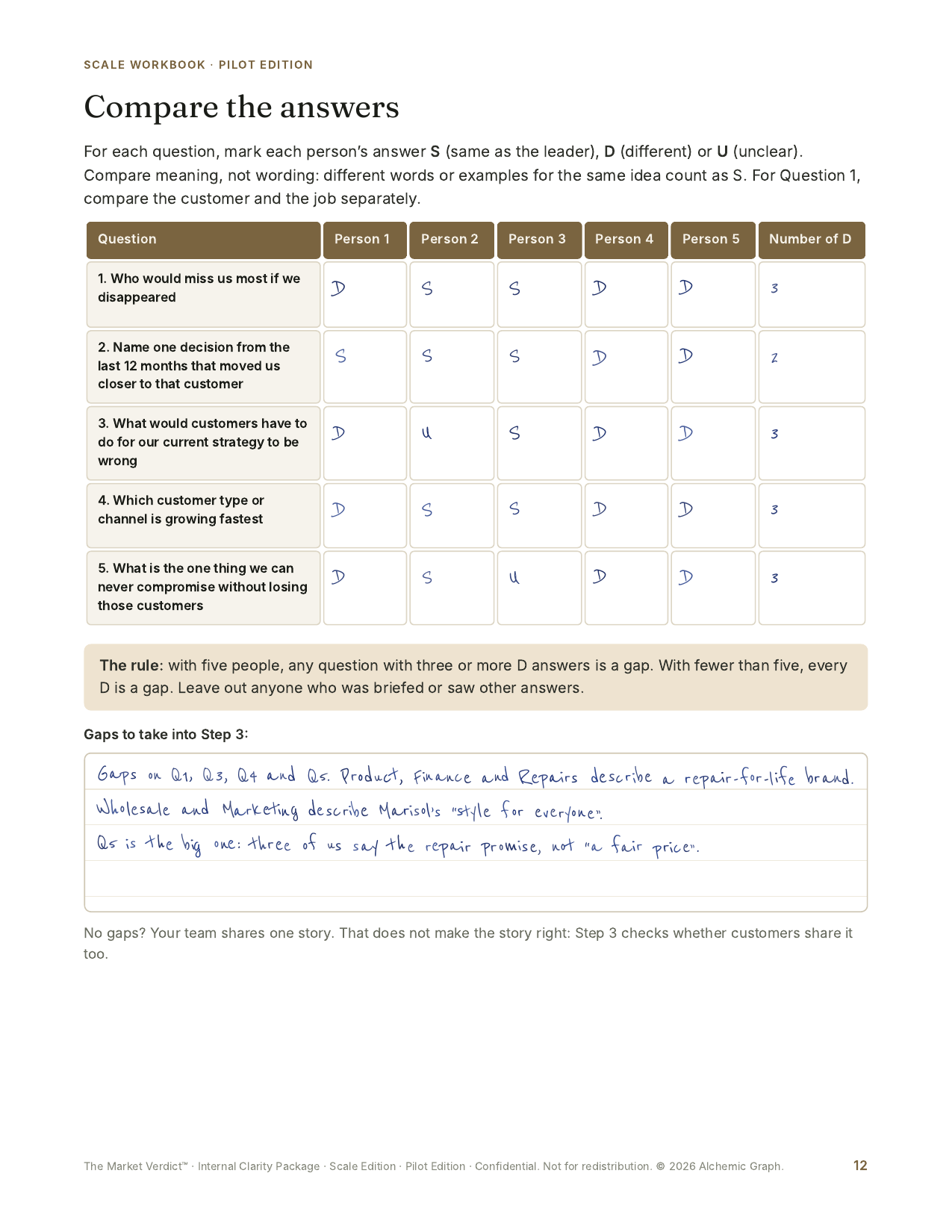
The team comparison. Fictional example. 5Gaps on 4 of 5 questions. Three leaders describe a repair-for-life brand; two describe the CEO’s.
Disagreement is a finding. Nobody had seen anyone else’s answers, so this is the first time the split was visible.
-
STAGE 4 · WEEK 4
They request the outside read
At the end of Step 2, the team requests its outside read on a short form. The form asks for a checkpoint phrase printed in their workbook, and never asks for their answers. We start researching Velmont from public evidence while they carry on with Step 3.
-
STAGE 5 · WEEKS 4–7
Step 3: they check it against customers
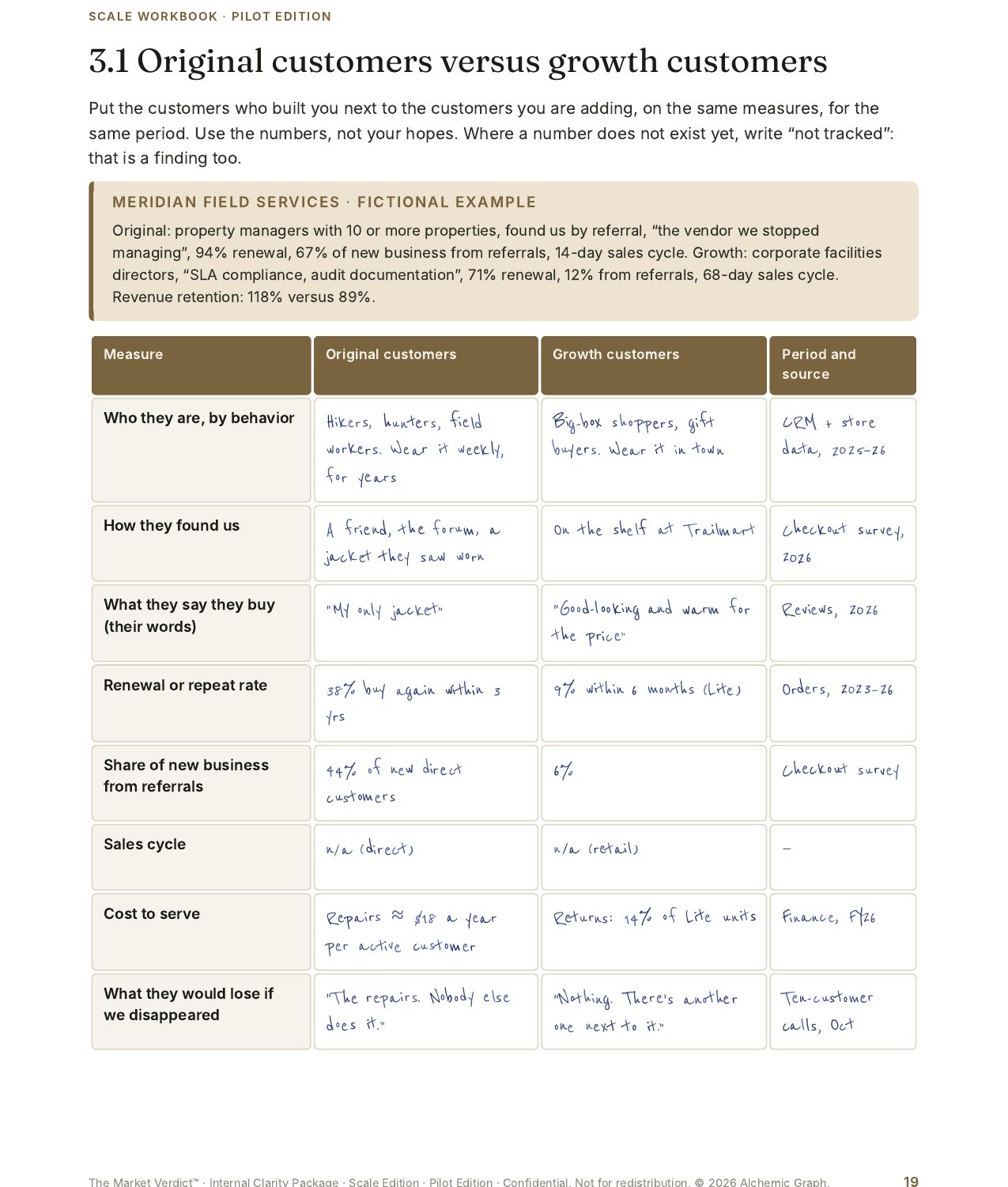 Full page ↗
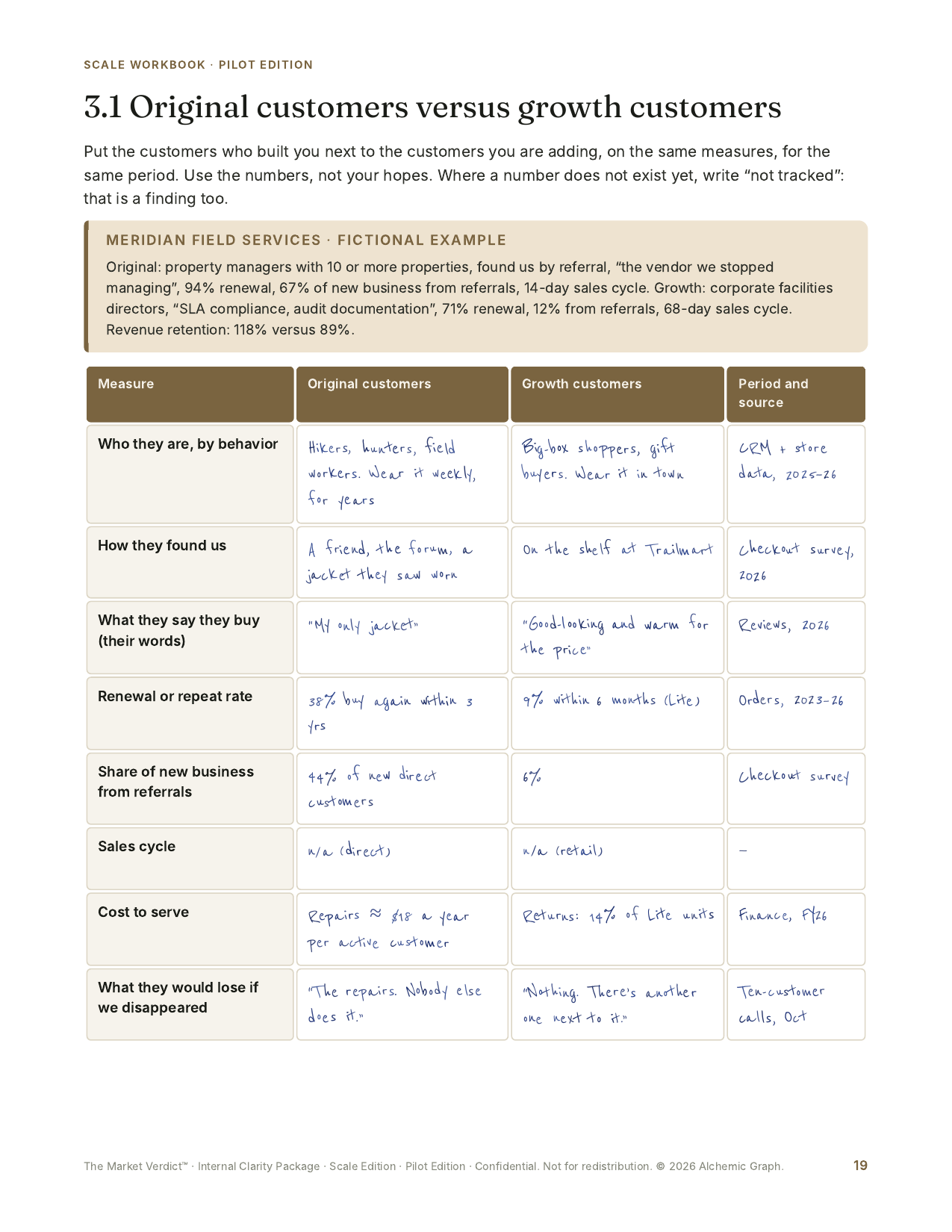
Original customers against growth customers. Fictional example. 6Their own order data: 38% of direct customers buy again within 3 years. 9% of Lite buyers within 6 months.
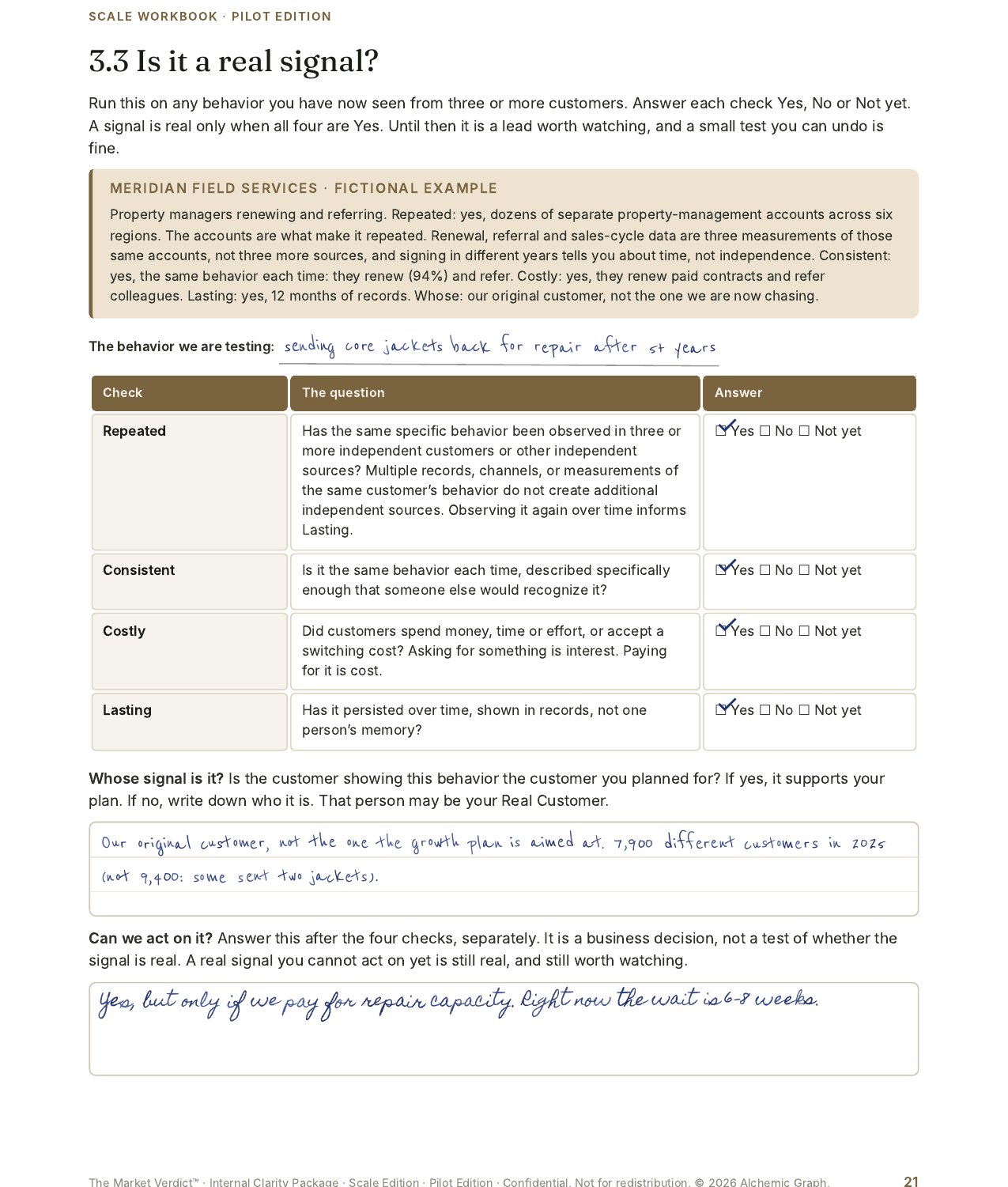 Full page ↗
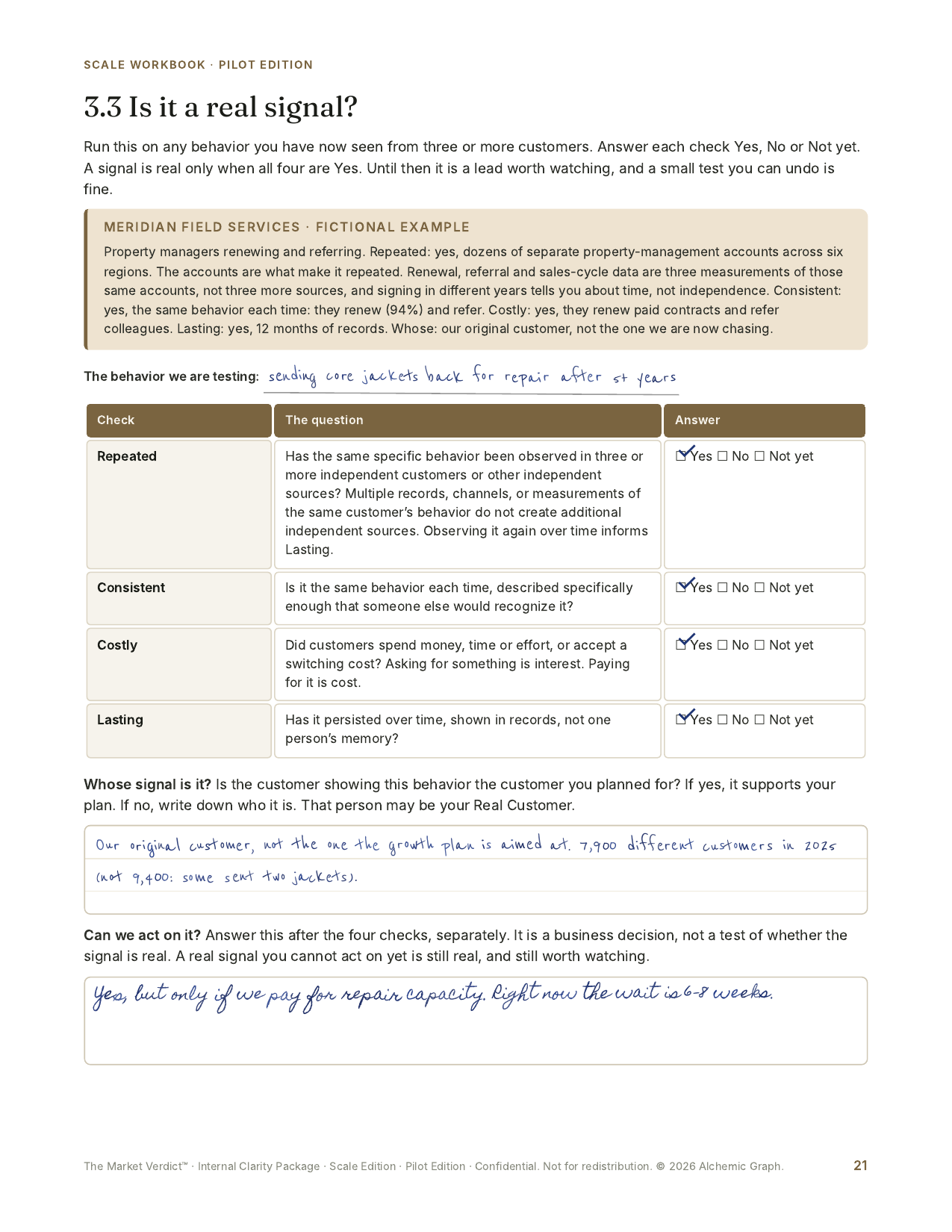
The signal test. Fictional example. 77,900 different customers, not 9,400 repairs. Independent customers count, not records.
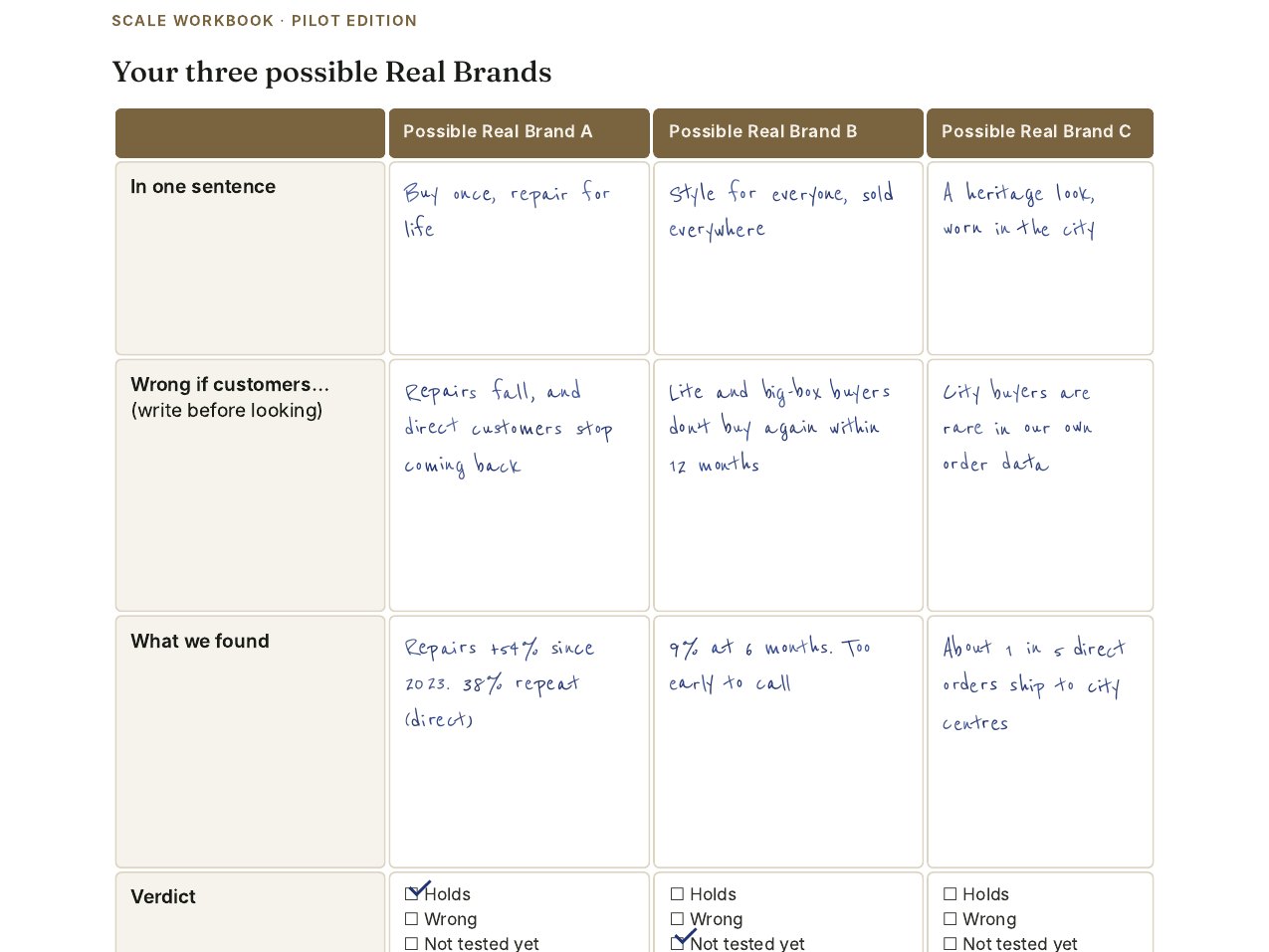 Full page ↗
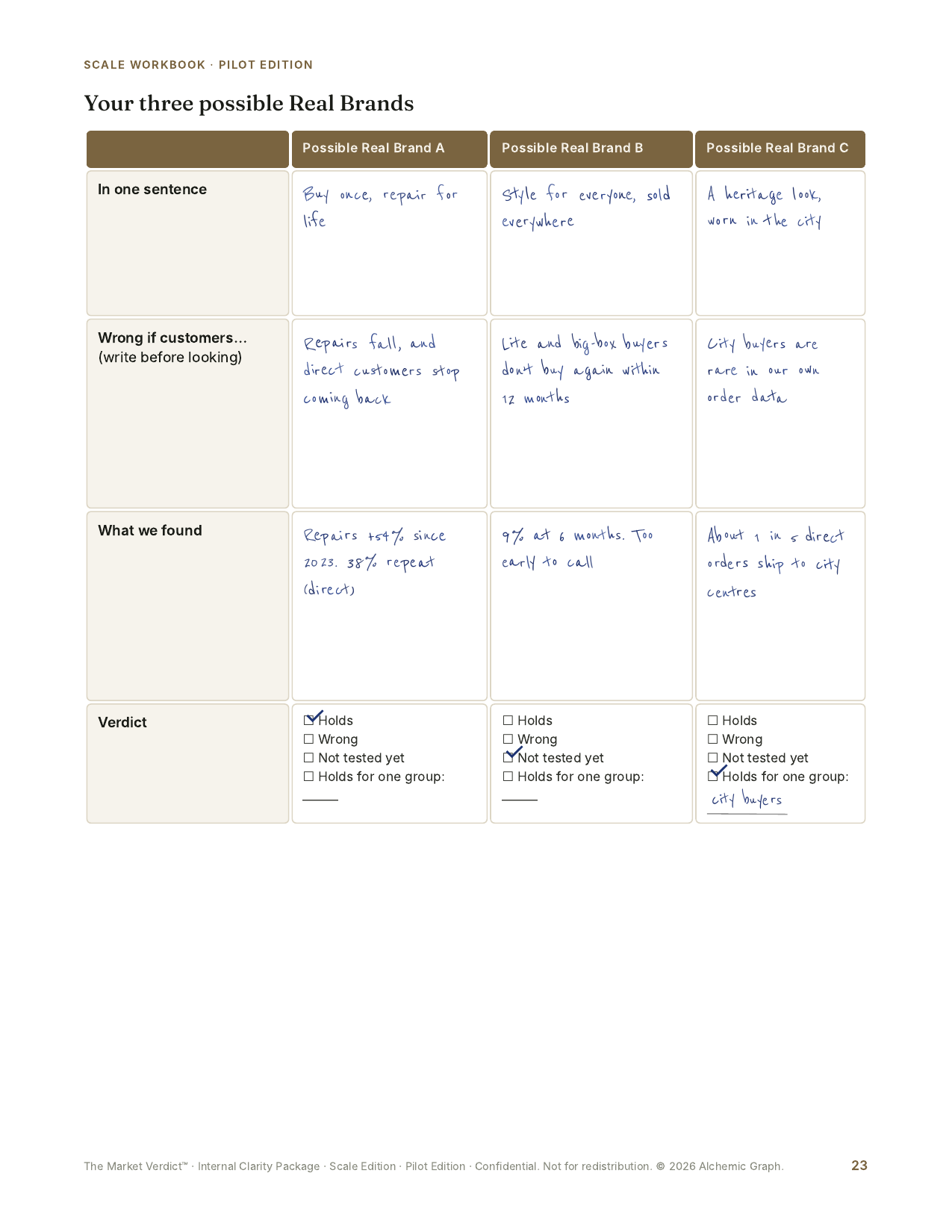
Three possible real brands. Fictional example. 8They mark the growth plan ‘Not tested yet’, because it’s only been 6 months. That’s an honest place to be.
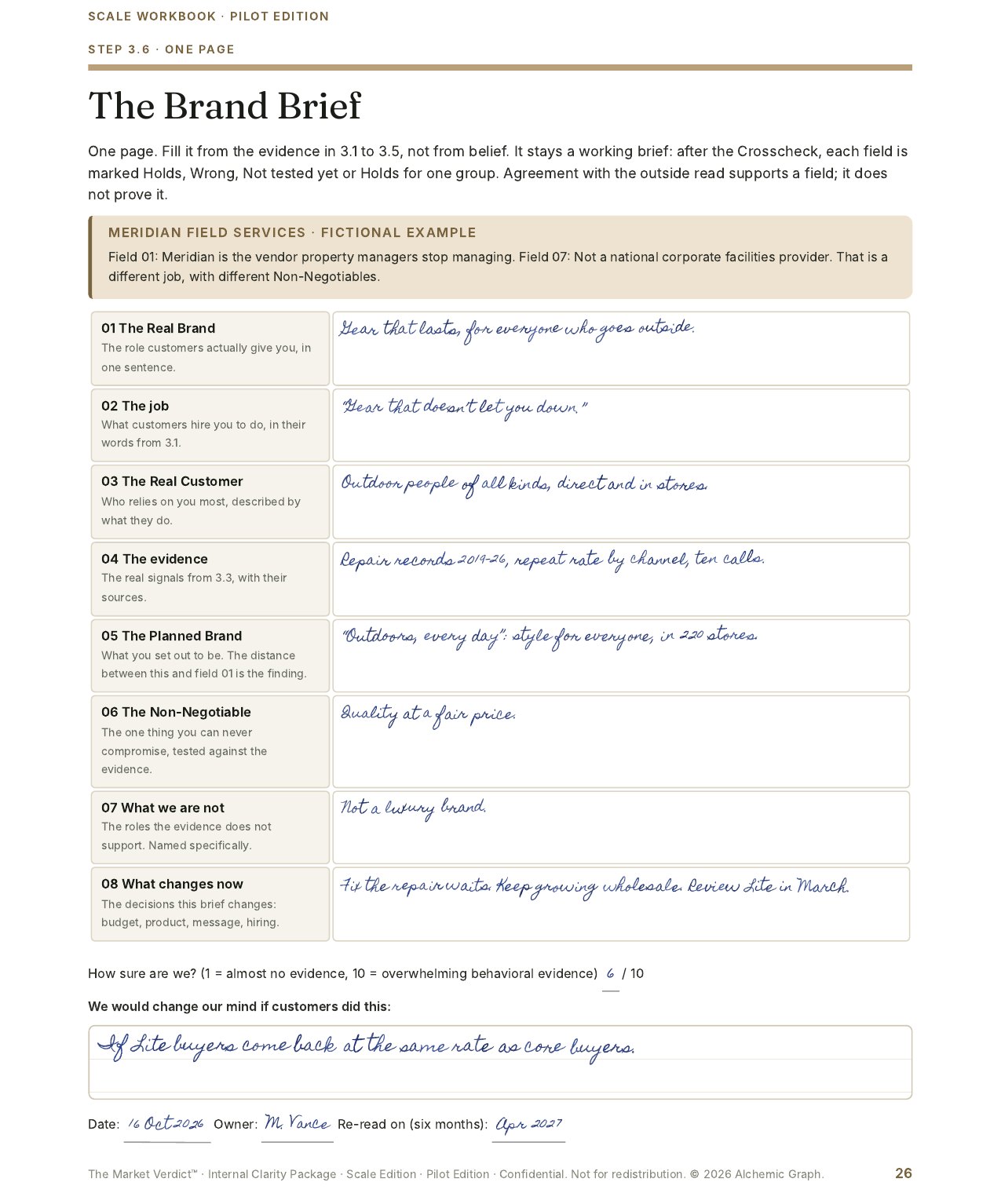 Full page ↗
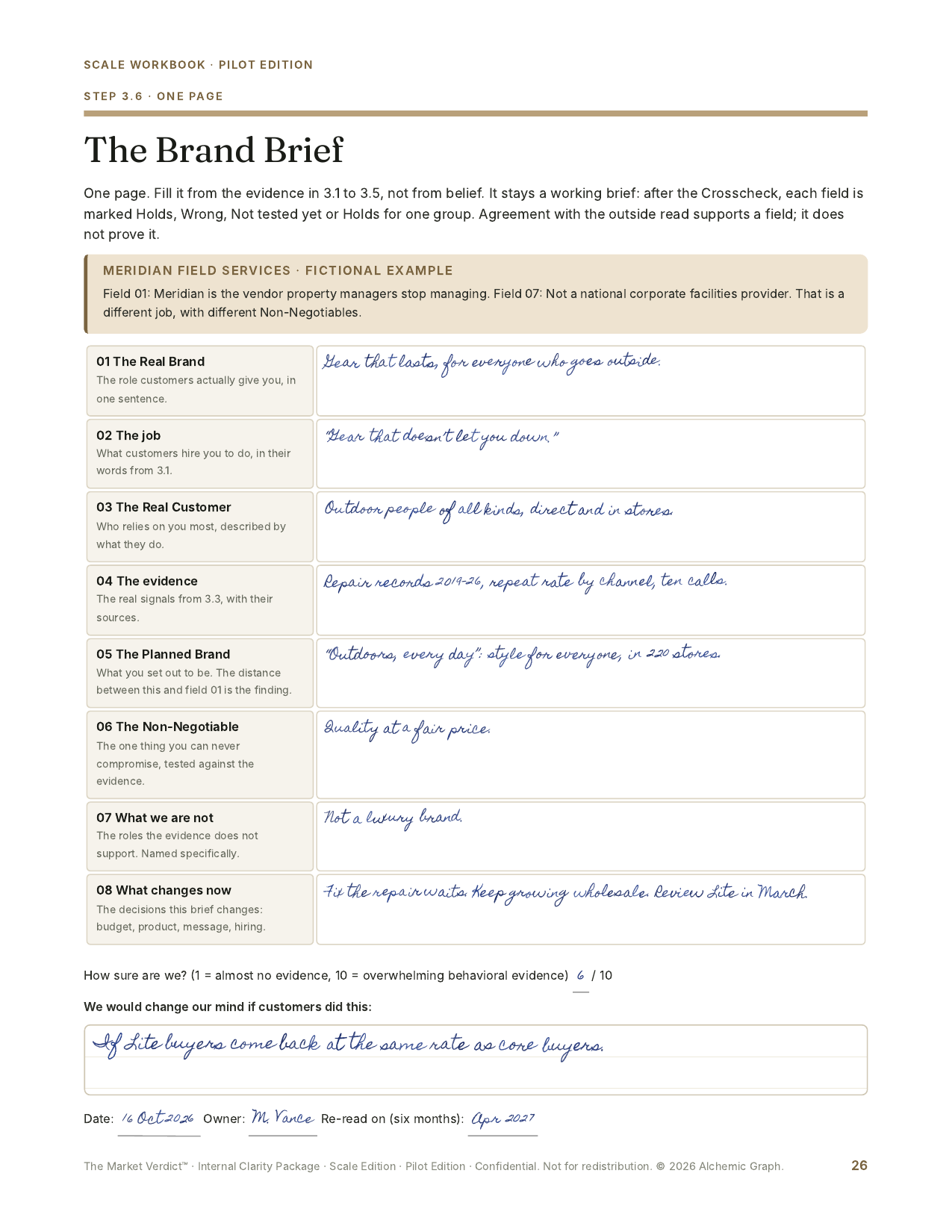
The team’s Brand Brief. Fictional example. 9Their Brand Brief tries to keep both: ‘Gear that lasts, for everyone who goes outside.’ Confidence: 6 out of 10.
-
STAGE 6 · WEEK 8
They seal their findings
Before seeing anything from us, they save a dated copy of their completed workbook. Their original answers can’t be changed by what the outside read says.
-
STAGE 7 · WEEK 8
The outside read arrives
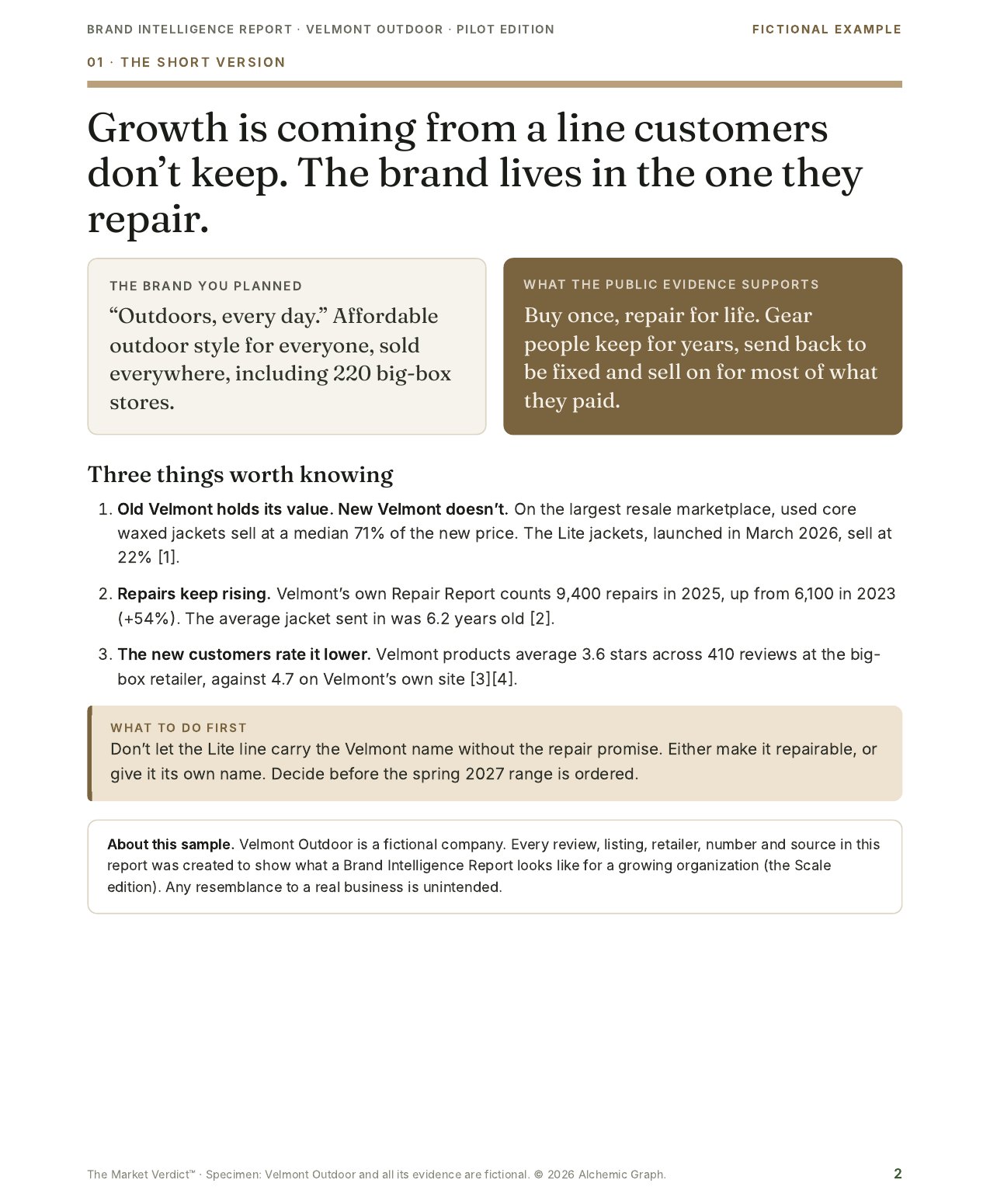 Full page ↗
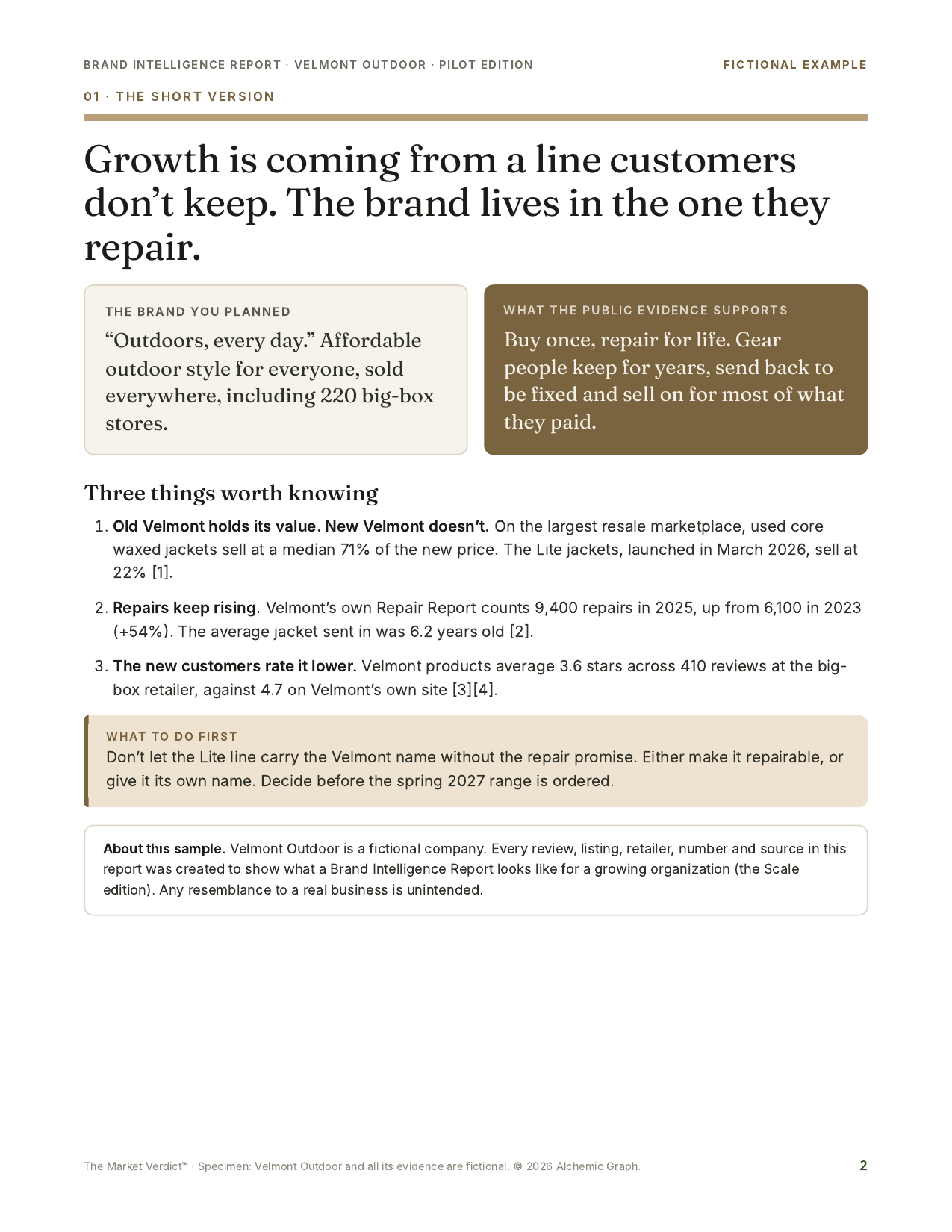
The short version of the outside read. Fictional example. 10Written from public evidence only, without seeing their workbook. ‘Growth is coming from a line customers don’t keep.’
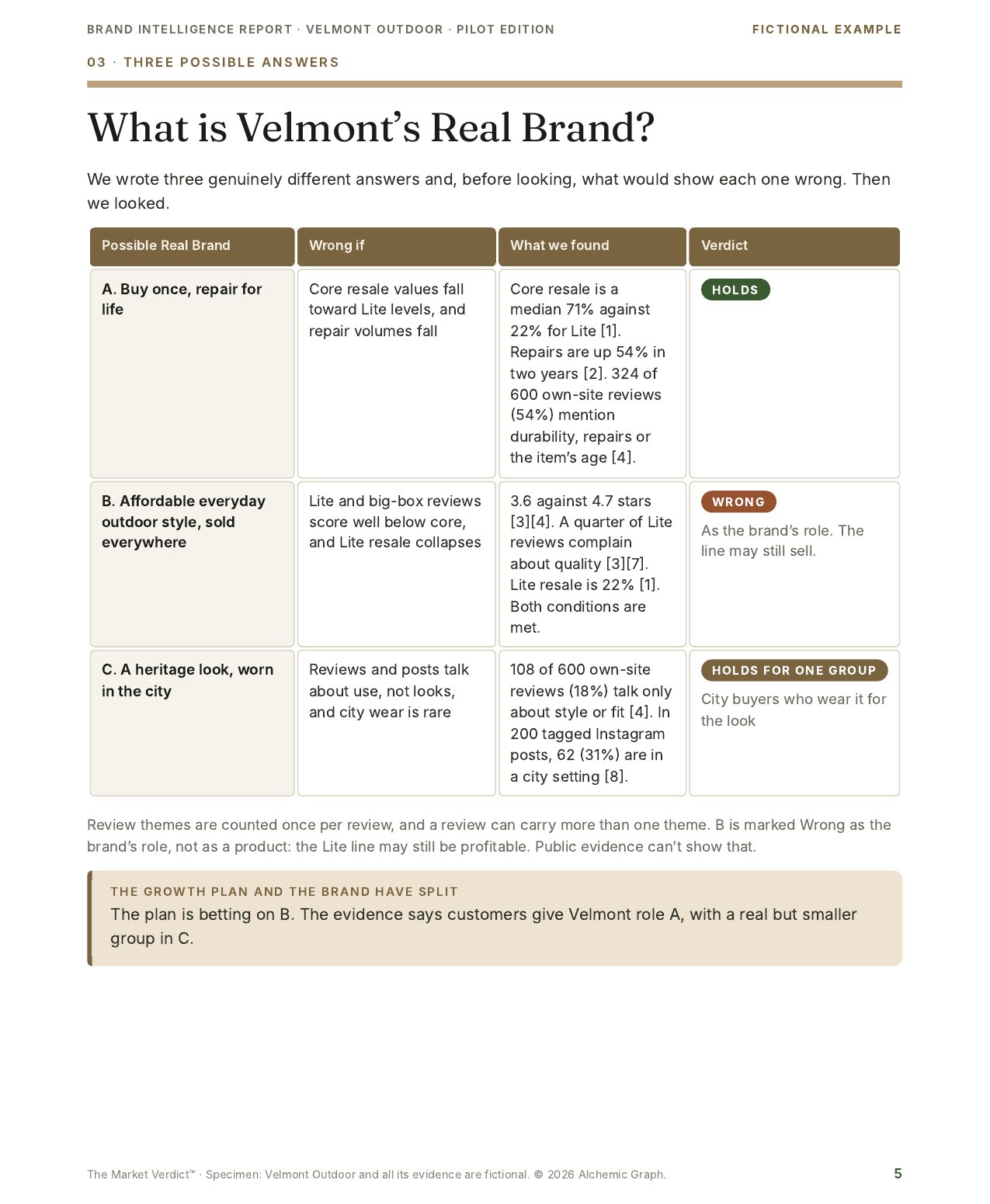 Full page ↗
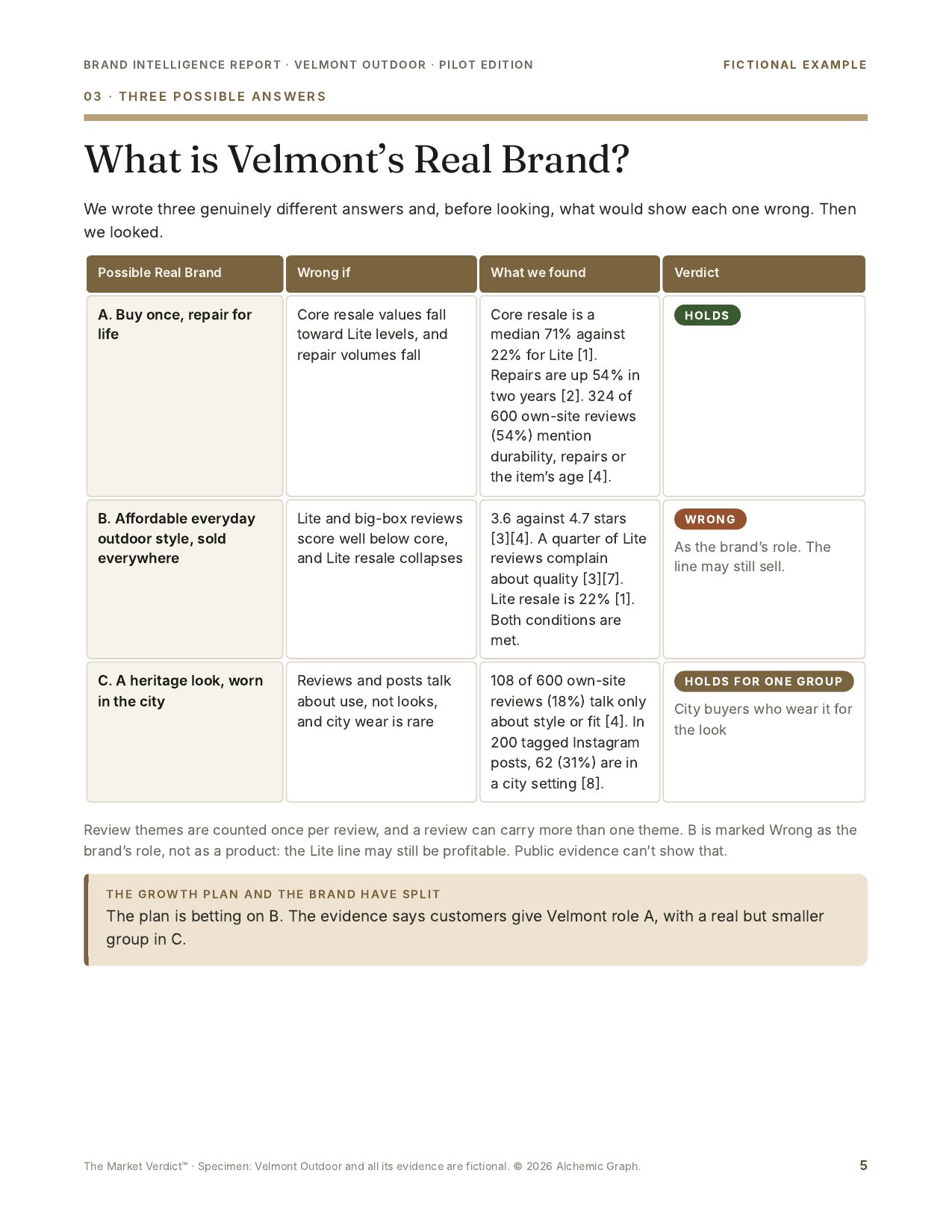
Three possible answers, with verdicts. Fictional example. 11The outside read marks the growth plan Wrong as the brand’s role. It doesn’t say the Lite line can’t make money.
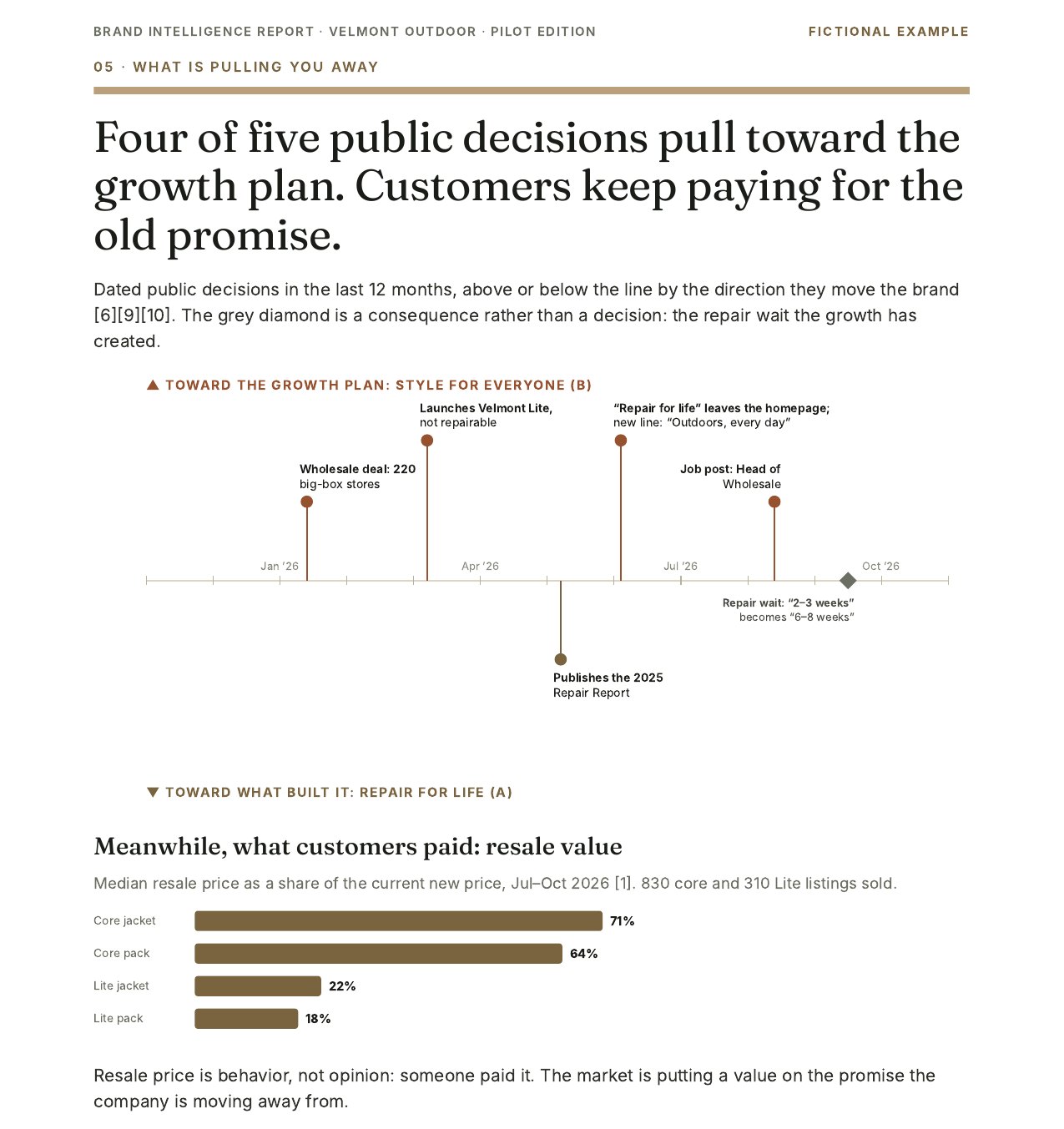 Full page ↗
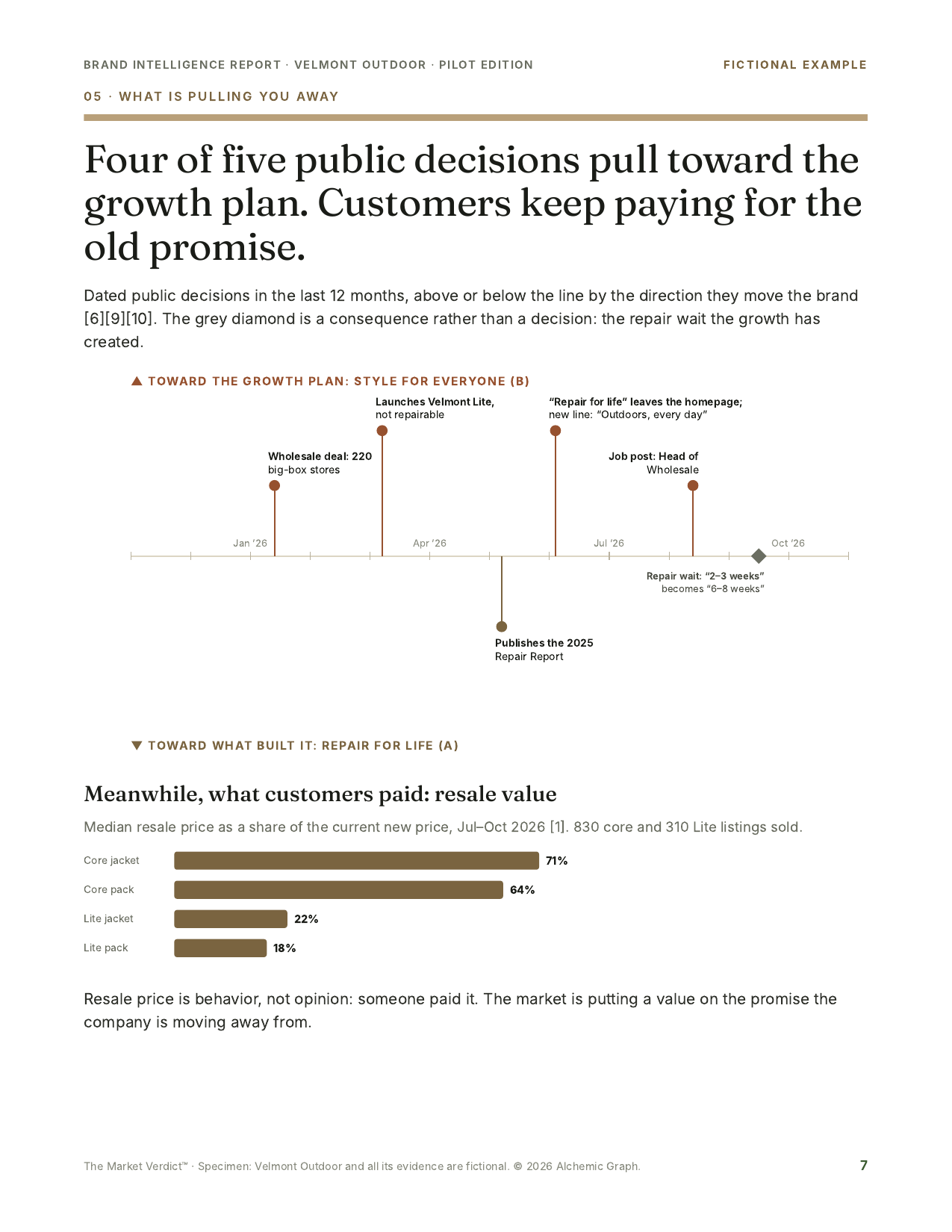
What is pulling the brand away. Fictional example. 12Read the full Brand Intelligence Report (fictional)Four of five public decisions pull toward the growth plan. Resale prices show what customers actually value.
-
STAGE 8 · WEEK 9
Crosscheck: the two sets of findings, side by side
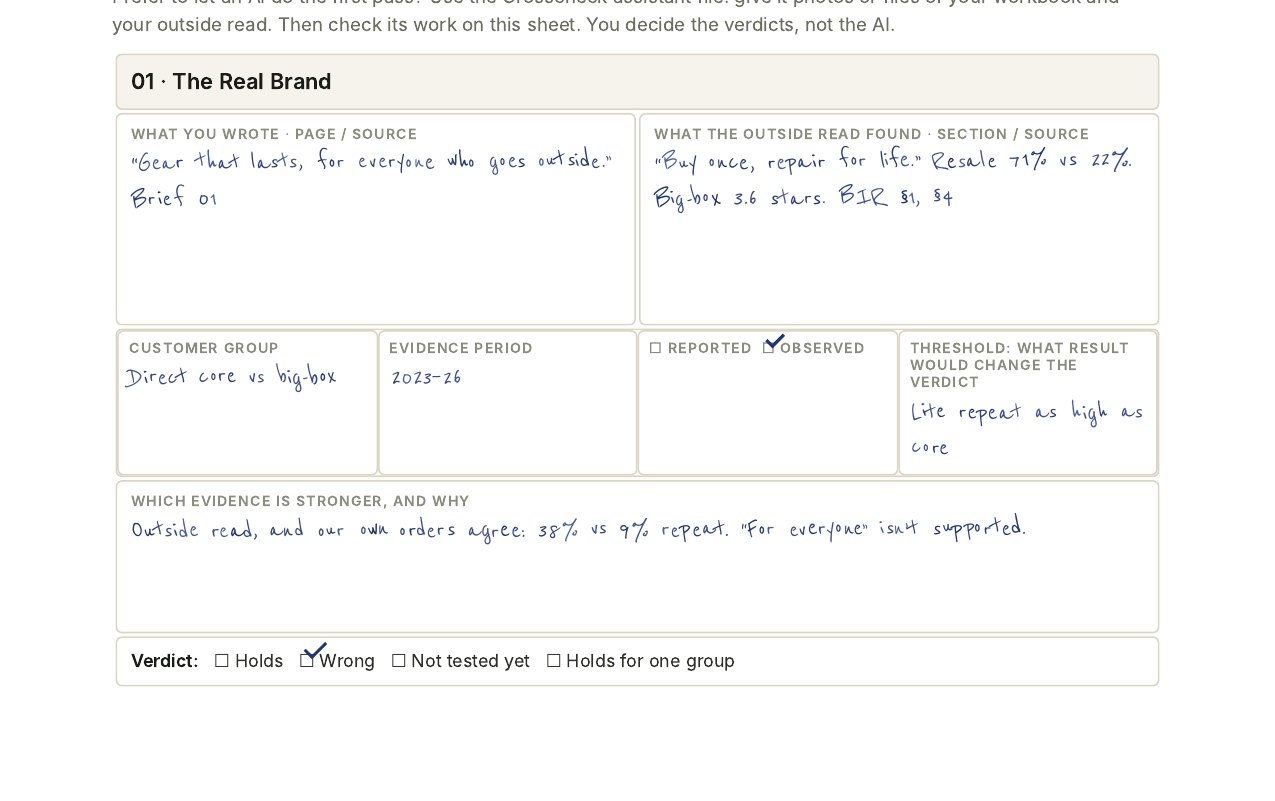 Full page ↗
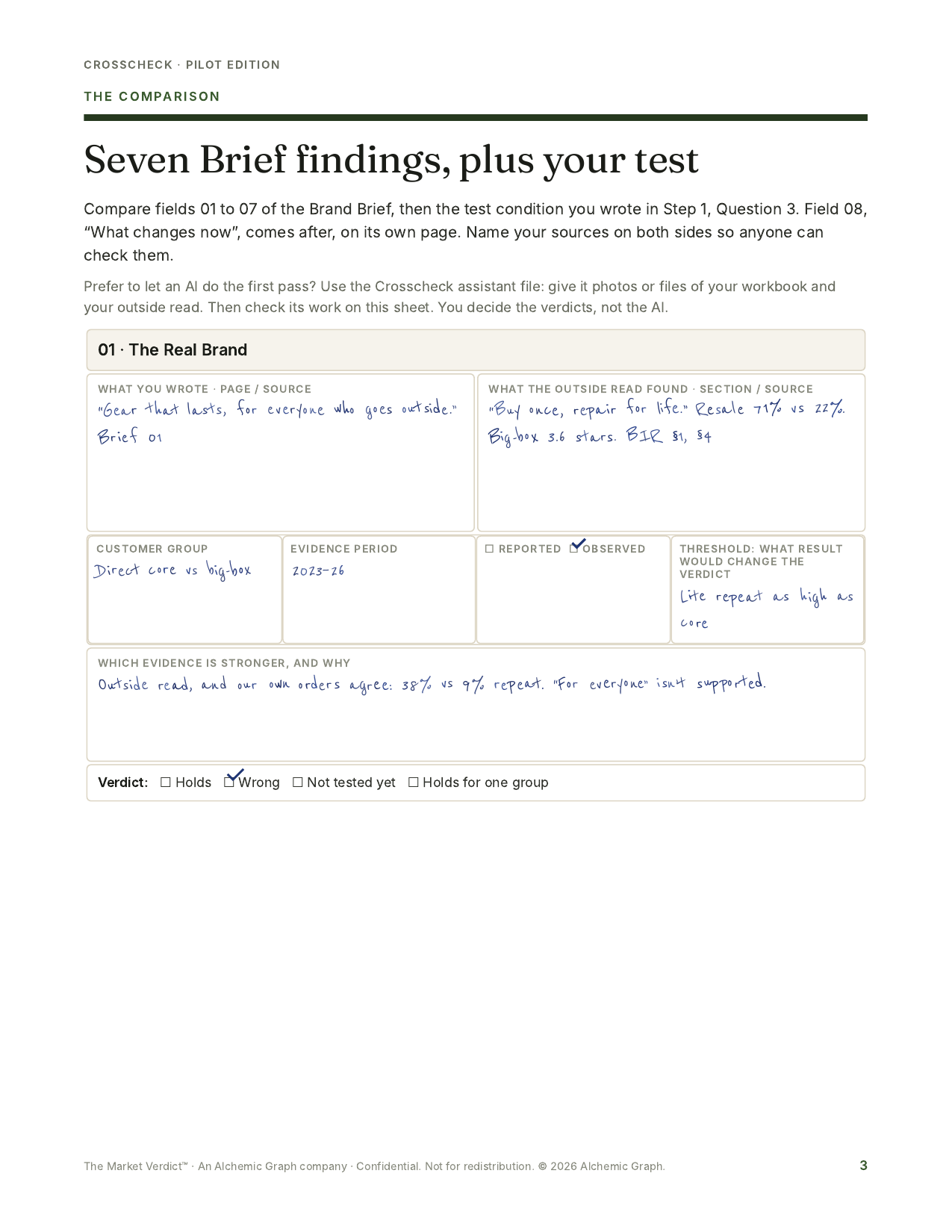
Crosscheck, field 01. Fictional example. 13Field 01. Their own private data agreed with the outside read. The stronger evidence wins, whichever side it’s on. Verdict: Wrong.
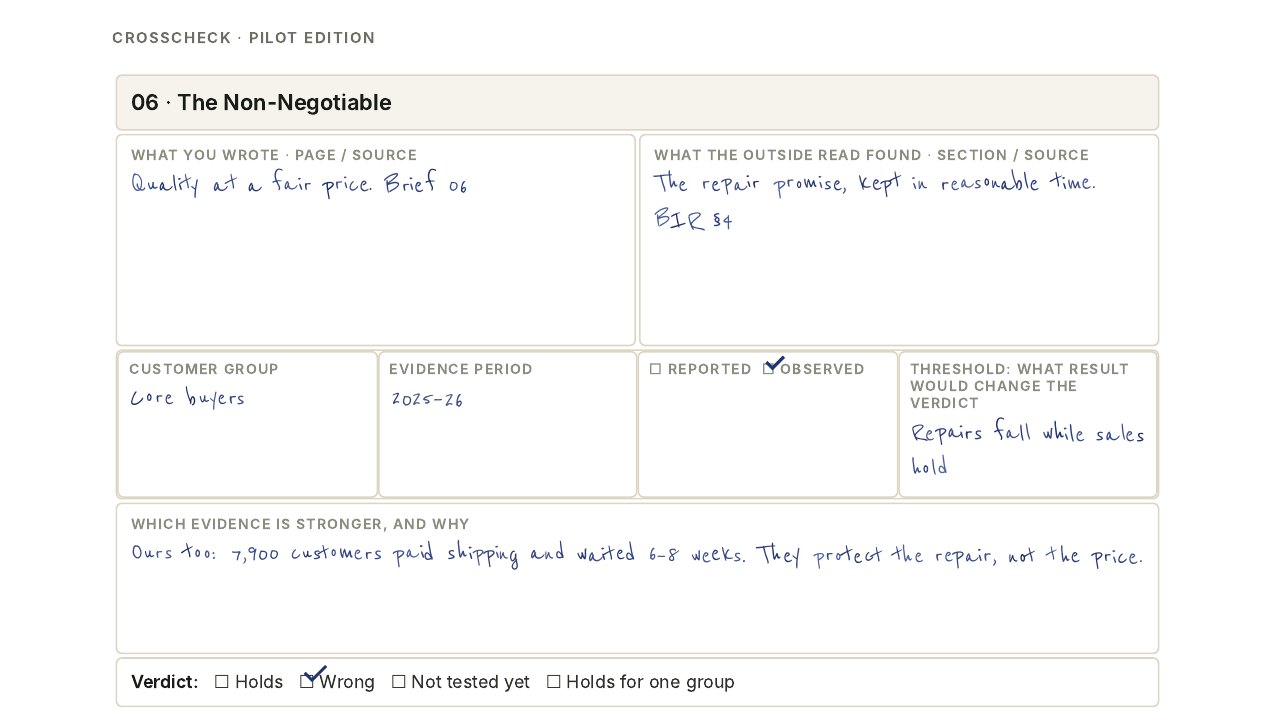 Full page ↗
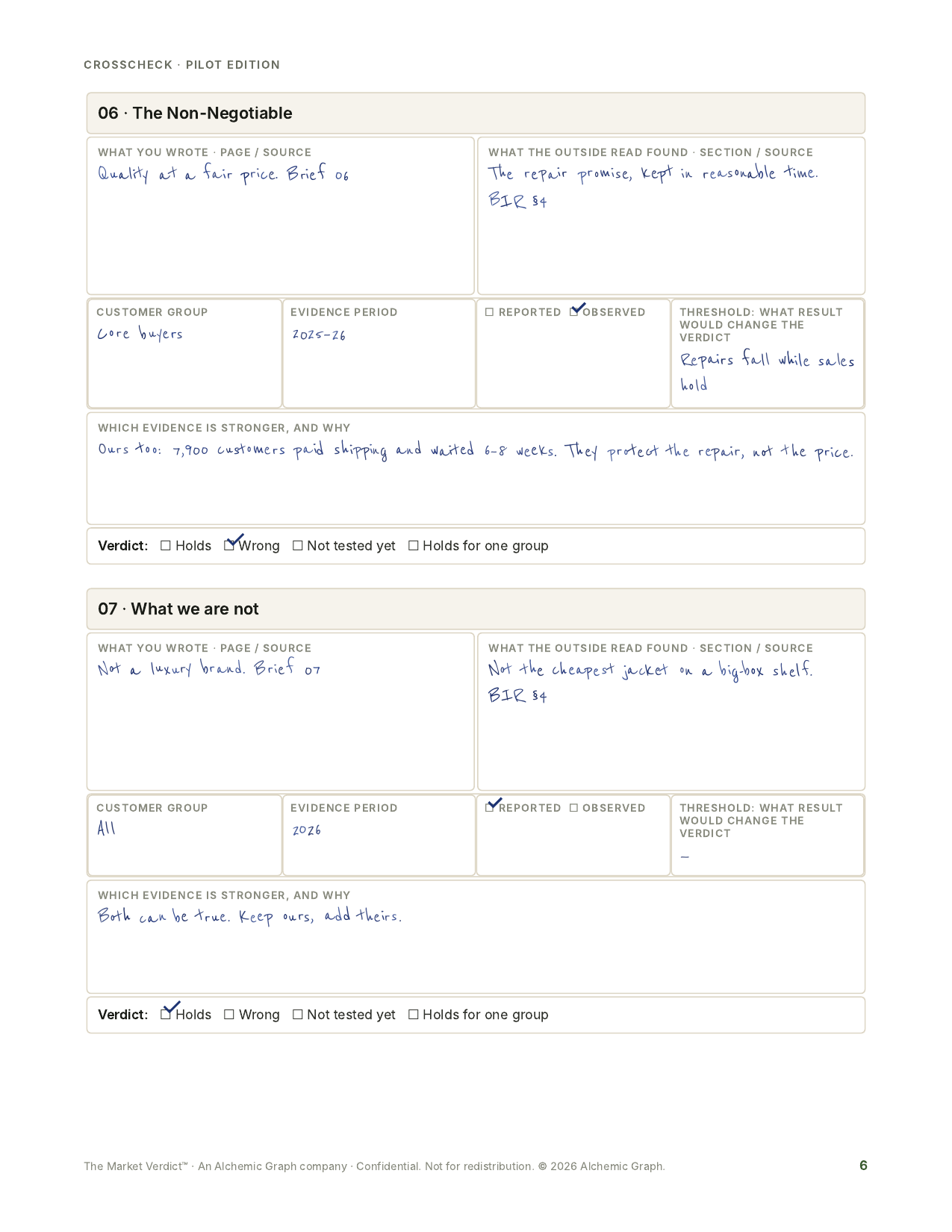
Crosscheck, the Non-Negotiable. Fictional example. 14The Non-Negotiable was never ‘a fair price’. 7,900 customers paid shipping and waited weeks for a repair.
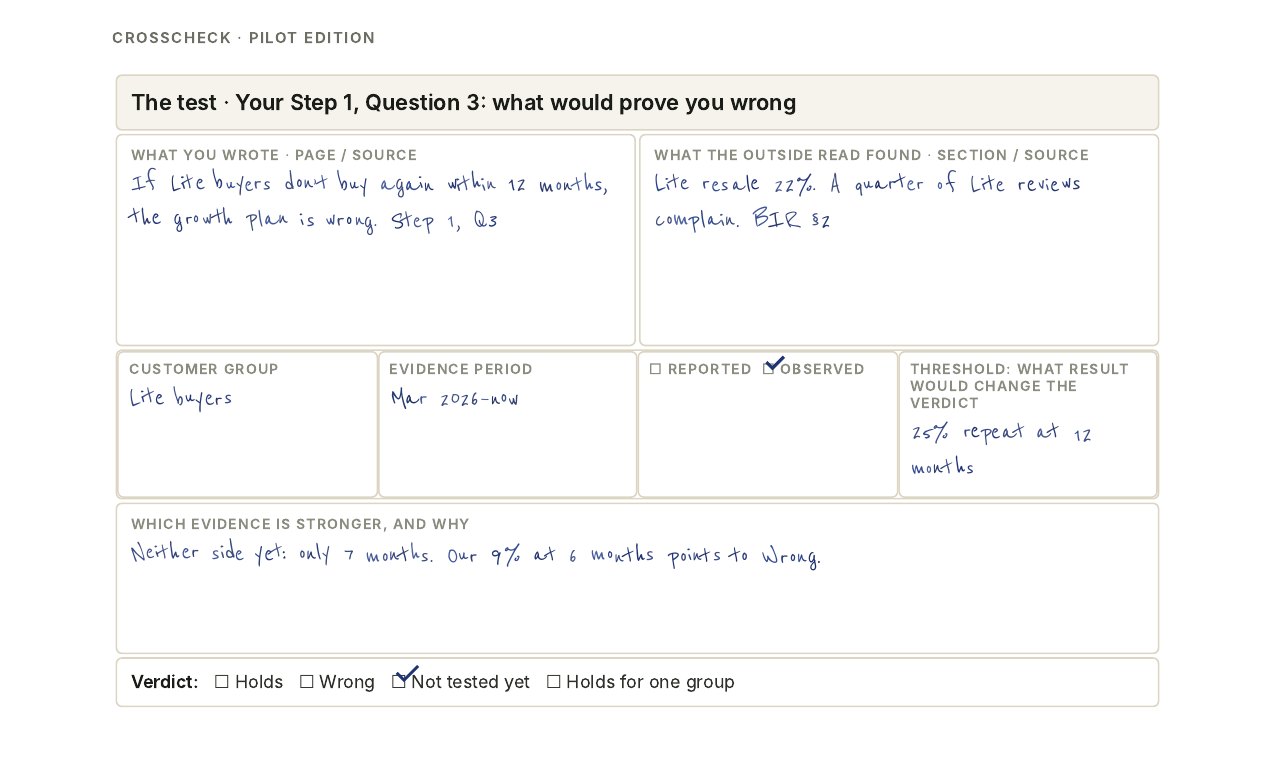 Full page ↗
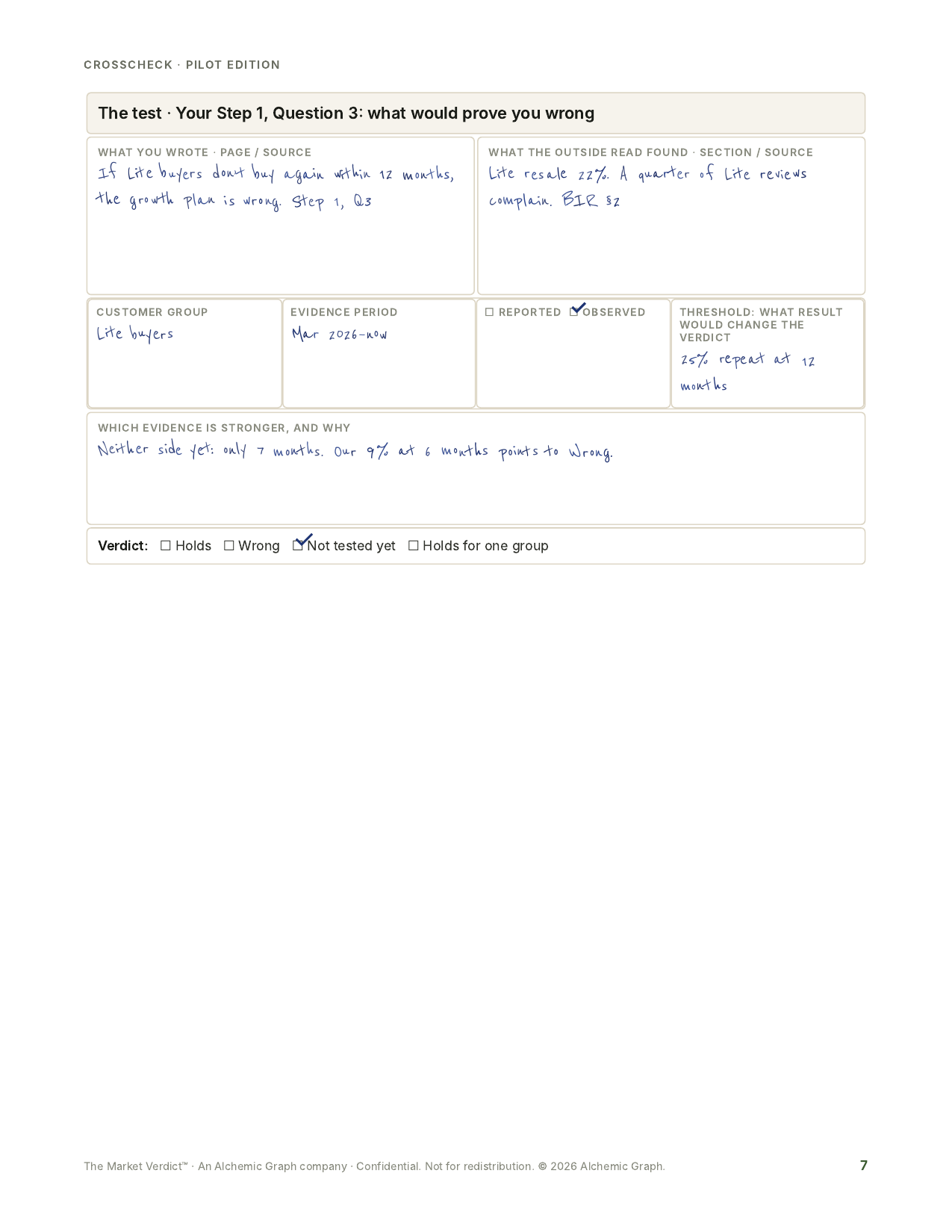
Crosscheck, the test. Fictional example. 15The CEO’s own test stays open. Not tested yet, until March 2027. Agreement is not proof, and neither is impatience.
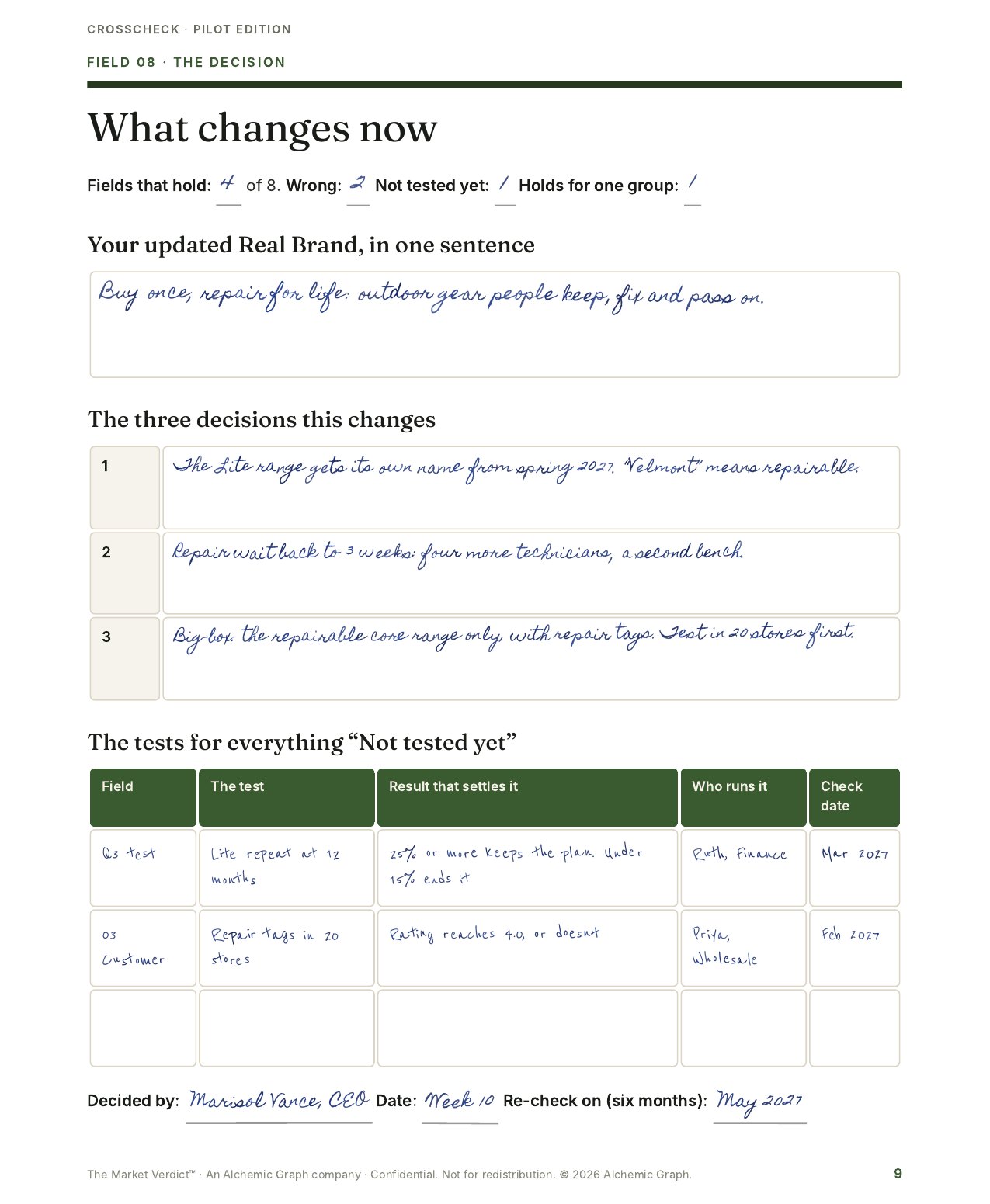
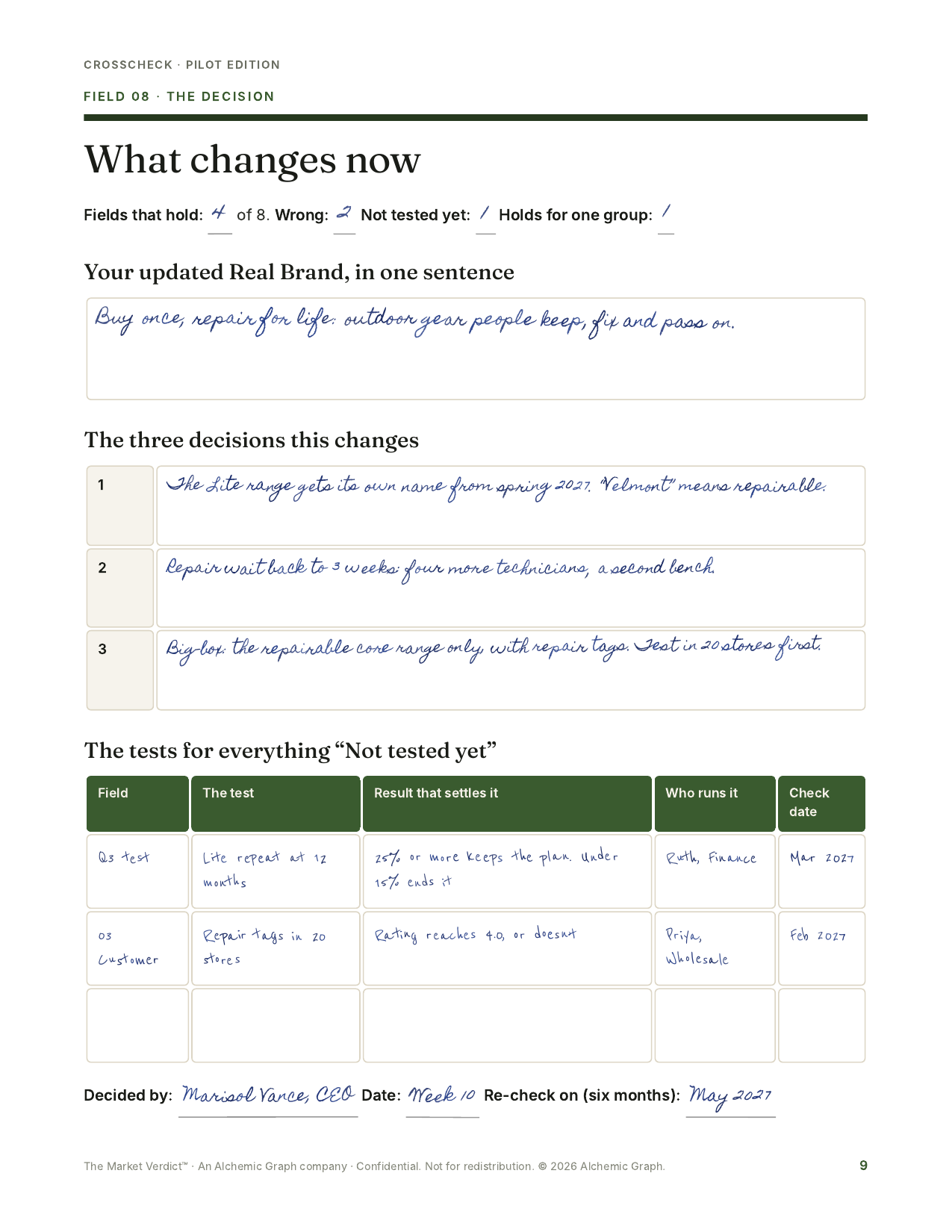
The result: 4 fields hold, 2 are wrong, 1 holds for one group, and 1 is not tested yet. A person signs every verdict.
-
STAGE 9 · WEEK 10
The decision
 Full page ↗
The decision page. Fictional example. 16The Real Brand, in one sentence: ‘Buy once, repair for life.’
17Three decisions: Lite gets its own name; repair waits go back to 3 weeks; only the repairable range goes into big-box stores, tested in 20 stores first.
18Every open question gets an owner and a date.
-
STAGE 10 · NEXT
What happens next
- Feb 2027Repair tags tested in 20 stores
- Mar 2027Lite 12-month repeat rate: 25% or more keeps the plan, under 15% ends it
- May 2027Six-month re-check of the Brand Brief
This is where the example ends. We haven’t invented results. In the pilot, the result is whatever customers do next.
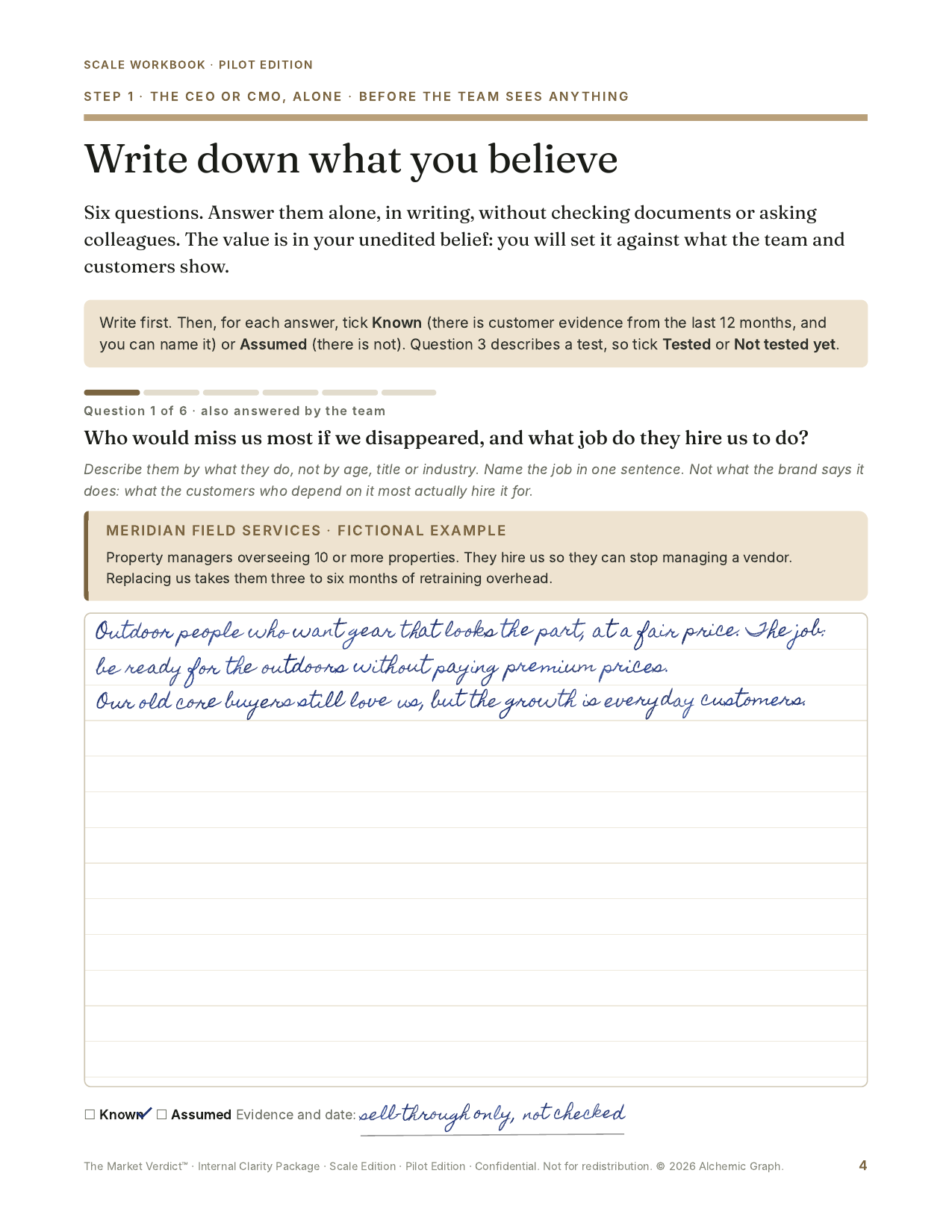
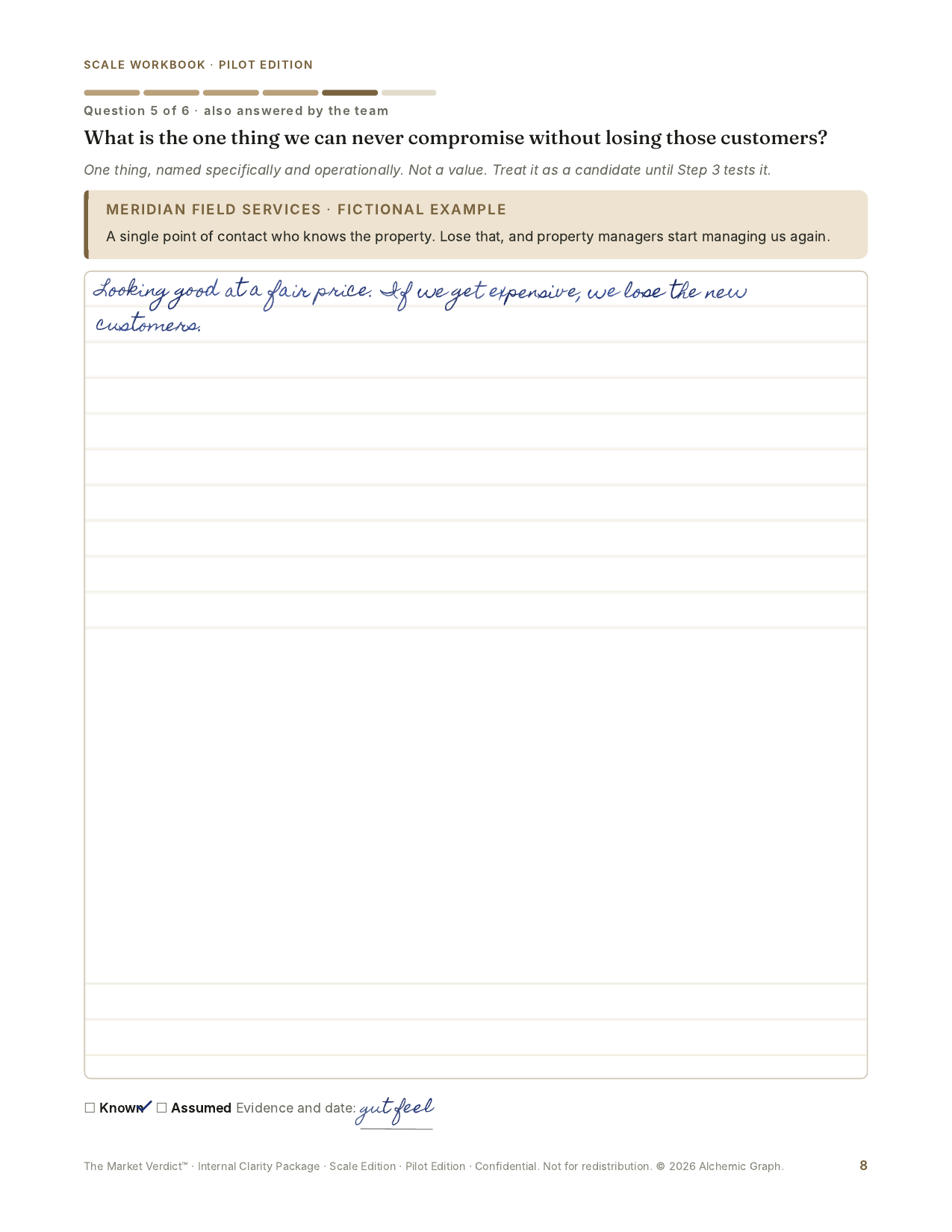
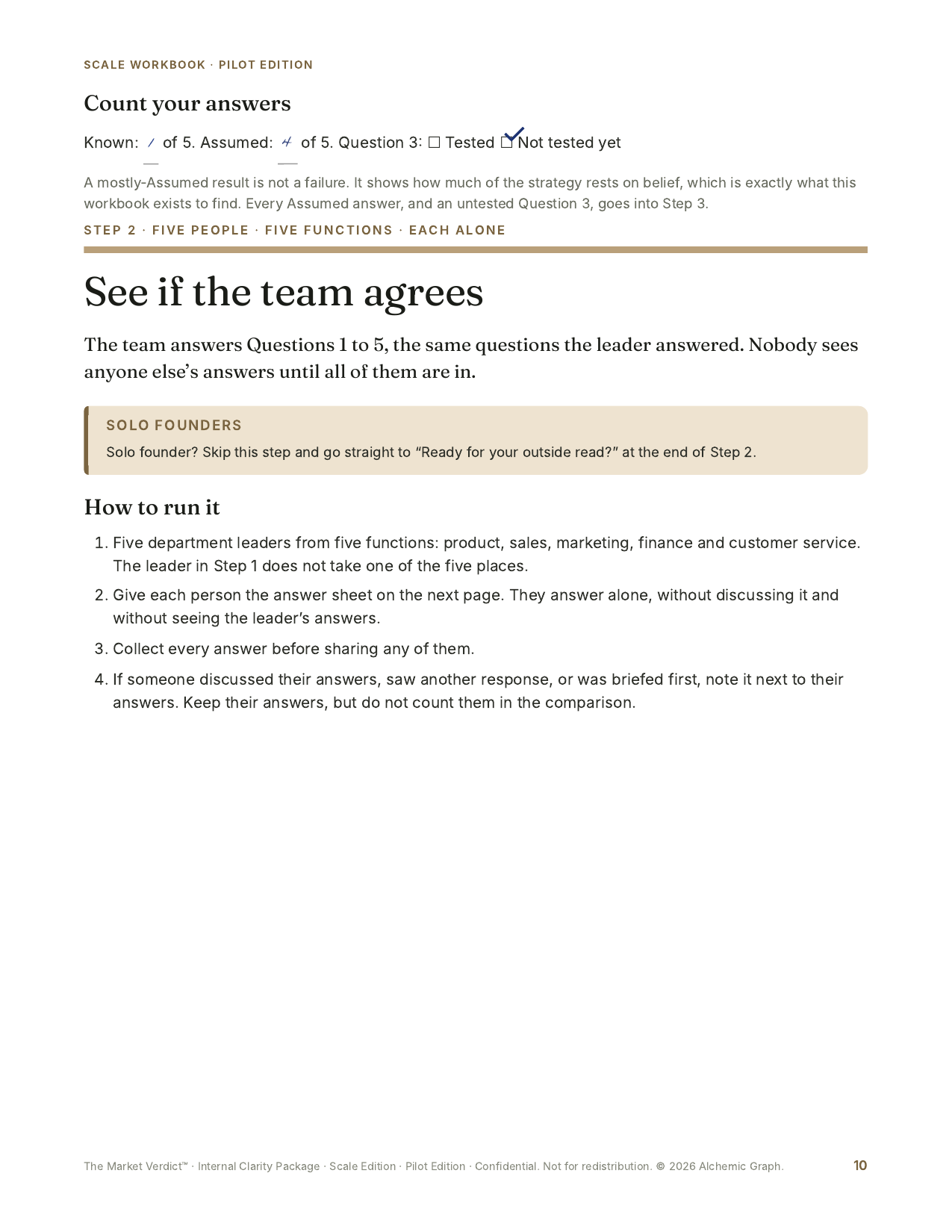
The full documents
Velmont Outdoor is fictional. Want to see a reading of a real company from public evidence? See the Starbucks sample (simulation).