Where The Market Verdict™ comes from
The Market Verdict starts where The Mom Test and Jobs to Be Done leave off. What it took from them, what it adds, and where it is still thinner.
By Benedict Talplacido, creator of The Market Verdict™
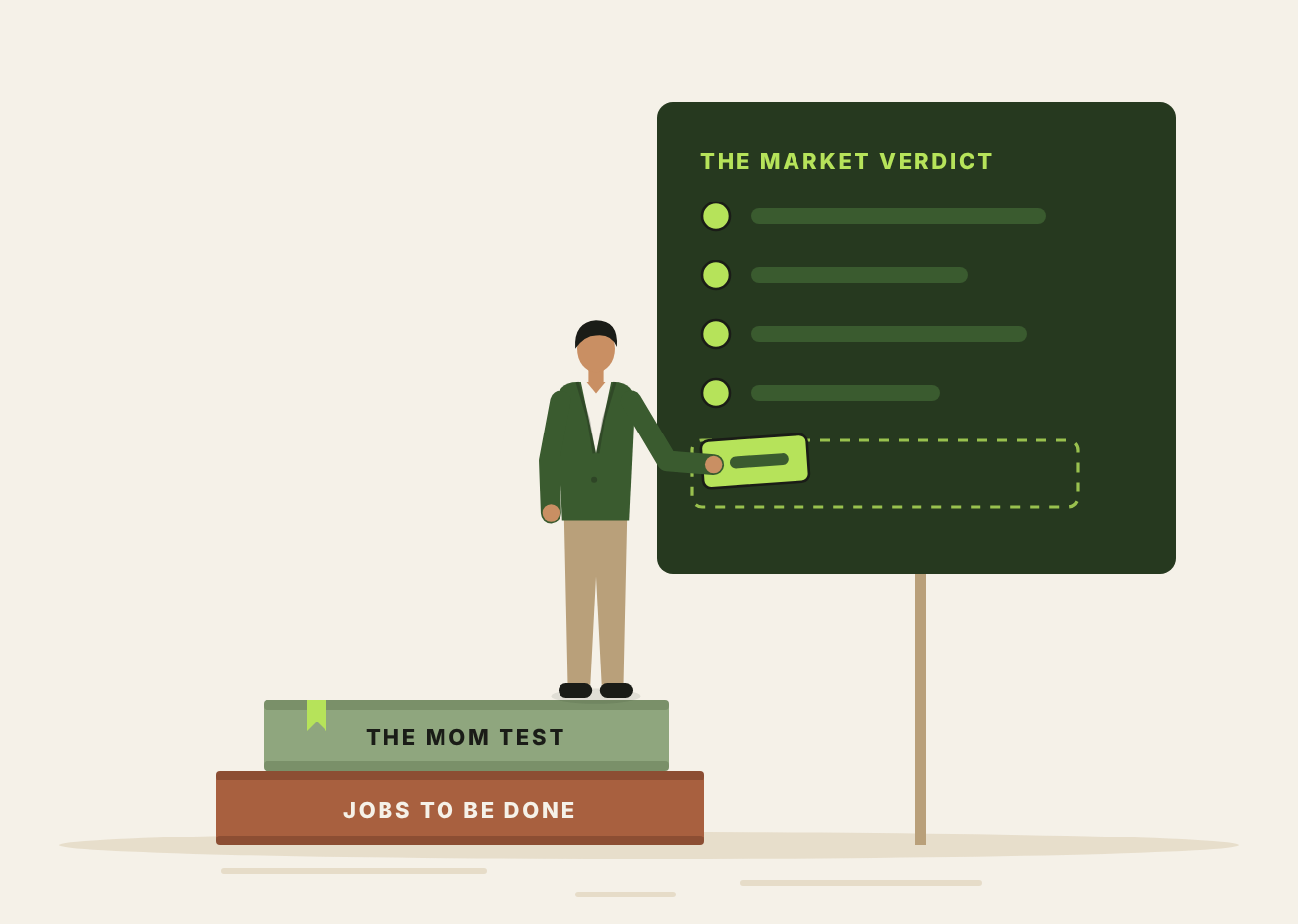
The Market Verdict starts where The Mom Test and Jobs to Be Done leave off. Those methods teach you how to learn from customers. The Market Verdict adds what comes before and after: your team writes down, alone and before talking to anyone, what it believes about why customers choose you. Then you test that against what customers do, and turn the result into a verdict you keep checking.
If you know those books, you will recognize things in the method. You should, because it builds on them. Here is exactly what I took, what the method adds, and where it is still thinner than the books it builds on.
How it started
Over 15 years of brand work I kept seeing the same pattern: companies measuring how customers felt about them, and missing what customers actually did. In October 2025 I started researching that gap on my own: where NPS and survey-led brand work fall short, and what customer behavior shows instead.
NPS was never the problem. It measures the temperature of the customer experience, and it does that well. What it can't tell you is why people bought, or what role you actually play in their lives. A score can hold steady while the reason customers choose you drifts underneath it. How NPS and The Market Verdict work together.
The first result was a book, The Real Brand, on the gap between the brand a company plans and the brand customers actually use. The Market Verdict first appeared inside it, as the idea underneath: markets form a verdict through behavior before companies notice. By the end of June 2026 I had set the book aside. A book explains a problem, but it doesn't help a team test its own beliefs. So I turned the idea into a method people can use.
That is still the purpose: give a team a way to check what it believes about its customers against what those customers actually do, while the gap is still cheap to fix.
Neither Jobs to Be Done nor The Mom Test asks a company to test its own story about its customers. That is the part I built.
Along the way, the method borrowed from two books, and they deserve the credit.
What I took from The Mom Test
The Mom Test starts from a simple idea: people will tell you what you want to hear. Rob Fitzpatrick's answer is to stop asking for opinions. Ask about specific things that happened in the past, and treat compliments as noise.
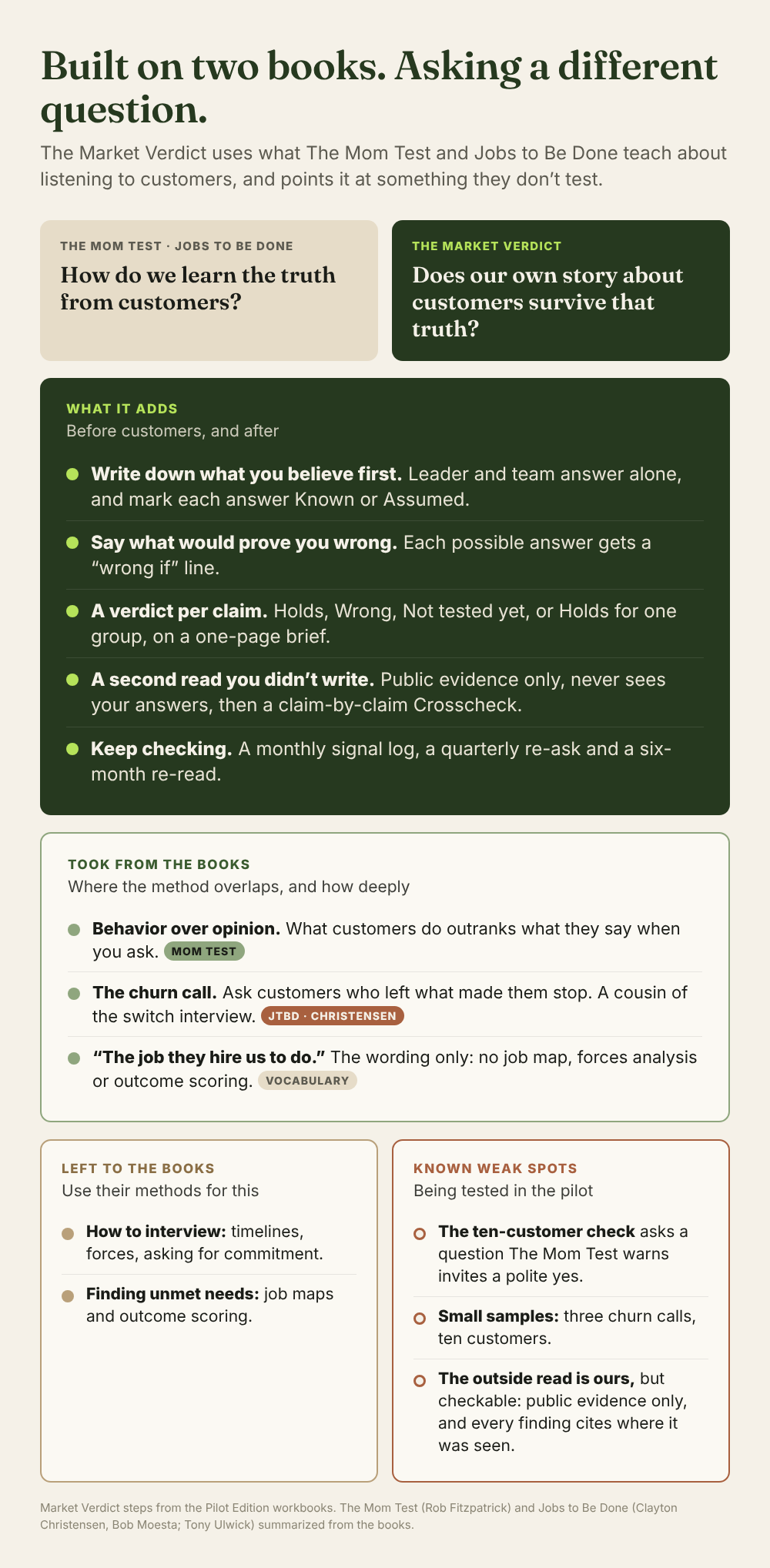
The Market Verdict makes the same bet. Our evidence ranking is the clearest overlap. At the top is what customers do: buying again, referring others, staying, leaving, paying more, using the product in a way you never planned. Below that is what customers say without being asked: reviews, support tickets, forum posts. Weaker still is what they say when you ask, in surveys and interviews. At the bottom, not evidence at all, is what your own team believes.
That is behavior over opinion, and the instinct is Fitzpatrick's. If you take one thing from this note, read his book.
What I took from Jobs to Be Done
Two things, and only one of them is structural.
The structural one is the churn call. In the Builder workbook, you call three customers who left in the last twelve months and ask one question: "What made you decide to stop?" Then one neutral follow-up, "Anything else?", and you write down exactly what they say. That is a cousin of the switch interview developed by Bob Moesta and colleagues in the Christensen school. People who stop using something tell you what they were really hiring it to do. In the coffee shop example in our workbook, the owners had been selling sourcing. The customers who left had been hiring a quiet place to work, and the music changed. A phone call found that. A survey would not have.
The other is vocabulary. Question 1 asks who would miss you most and what job they hire you to do. I borrowed the phrase because it is the clearest way I know to ask what someone actually uses you for.
The machinery did not come with it. In The Market Verdict, "the job" is a one-sentence label that feeds the Real Brand. There is no job map, no desired-outcome statements, and no importance-versus-satisfaction scoring of the kind Tony Ulwick built into Outcome-Driven Innovation. If your question is which customer needs are underserved, use Ulwick's methods. Ours is a different question.
The gaps it fills
The Mom Test and Jobs to Be Done assume you already know what to ask and whom to ask. The Market Verdict works on both sides of that. Before talking to customers, it tests what the company believes. After, it turns what you learn into a verdict and keeps checking it.
The company's own beliefs. In Step 1 the leader answers six questions alone, in writing, and marks each answer Known or Assumed. In Step 2 the team answers the same questions on their own, and where answers differ, that is a gap. Everyone goes on to customers even if the team agrees, because agreement only means you share a story.
What would prove you wrong. You write up to three genuinely different answers to "What is our Real Brand?", each with what customers would do if it were wrong. Then you judge the evidence against that line, not against how the answer feels.
A verdict, not a mood. Every answer gets one of four verdicts: Holds, Wrong, Not tested yet, or Holds for one group. Everything ends on a one-page Brand Brief: the role the evidence supports, what is uncertain, how sure we are from 1 to 10, and what customers would have to do to change our mind.
A second read you didn't write. We read your market from public evidence without ever seeing your workbook. You save a dated copy of your findings first, then the Crosscheck sets the two reads side by side, claim by claim. Agreement supports a claim; it does not prove it, because two reads can share a blind spot.
A habit, not a project. Monthly, you review the signal log. Quarterly, you ask the same people Question 1 again, alone. Every six months, you re-read the brief and ask whether behavior still supports it.
None of this replaces how those books teach you to talk to customers. Use their methods for that. These steps sit around them and test whether the company's story survives what you hear.
Where it is still thinner
An extension should say where it falls short of what it extends. Three places.
The ten-customer check goes against The Mom Test. You describe your answer to ten customers and ask three fixed questions. The first, "Does this describe a real problem you've had?", is one people can answer yes to politely. Fitzpatrick would likely flag it. I kept it to sharpen the words, not to prove the answer: the value is in the second question, where customers rephrase the idea in their own words, and the third, where surprise points to a gap. I want those words. I do not want the yes. The pilot will tell me whether it earns its place. If it doesn't, it becomes a check that asks for a commitment instead of an opinion.
"Before you look" isn't fully before yet. In the current pilot, some evidence-gathering comes before you write what would prove you wrong. Tightening that order is on my list.
The outside read is ours. We make the method too, so we are not a neutral party. What keeps the read honest is what it is built from: public evidence only, and every finding says where we saw it. You can check each one yourself. And what we count, and how much it weighs, follows the same rules the workbook uses: the evidence ranking and the four-check signal test. Applying them still takes judgment, which is why every finding shows its source.
Where it goes from here
The method has changed a lot since the book. In June 2026 it became a full written system with four workbooks. Over the summer I ran it on public companies and ideas as practice, reviewed every sentence line by line, and designed the Crosscheck. In October I rebuilt it for the pilot in plain language: three steps, six questions. Pilot intake opened on October 23, 2026.
Next, the first pilot teams get their materials, their outside reads and their Crosschecks. Then I publish what the pilot found, including what went wrong. The app, the same workbook online, is in design. Pricing waits until the pilot evidence is in. And on March 20, 2027, our first predictions about well-known brands go on public record, misses included.
Every step, with dates from the working files, is on the roadmap.
Why say any of this
Because the method is in pilot, and the pilot is how I find out what is wrong with it. The books it builds on are better established than anything I have made, and they deserve to be named. Where The Market Verdict agrees with them, I would rather you hear it from me. Where it extends them, judge the extension on its own evidence.
If you have run these methods and see something I got wrong, tell me. I read every report.